Options remain open
- Understanding is developing
- Many paths remain available
- Learning can still change direction
Decision discipline under uncertainty
DECODE is a discipline for committing only when understanding is sufficient.
The Cost of Acting Before Understanding
Decision space
Cost of reversal
Understanding
Commitment
Execution
The cost of acting before understanding
Commitment removes optionality. It creates dependencies, aligns stakeholders, and makes reversal increasingly costly, even while understanding is still developing.
Do not confuse these
Pressure to act arrives before shared understanding. The problem, system boundary, or justified direction is still unclear.
The goal and direction are sufficiently understood, but delivery is failing through slippage, defects, or weak discipline.
Optionality and boundaries
Optionality becomes useful when the system and its real boundaries are understood. DECODE does not preserve every imaginable option. It protects the options that remain legitimate.
Explore change boundaries →The DECODE method
The sequence is exact. Each stage constrains the next and prevents a decision from quietly forming too early.
Why is change being considered?
What system actually exists?
Which past decisions shaped the present system?
What must not be crossed?
What level of commitment is justified?
How will the decision remain explainable?
Three legitimate outcomes
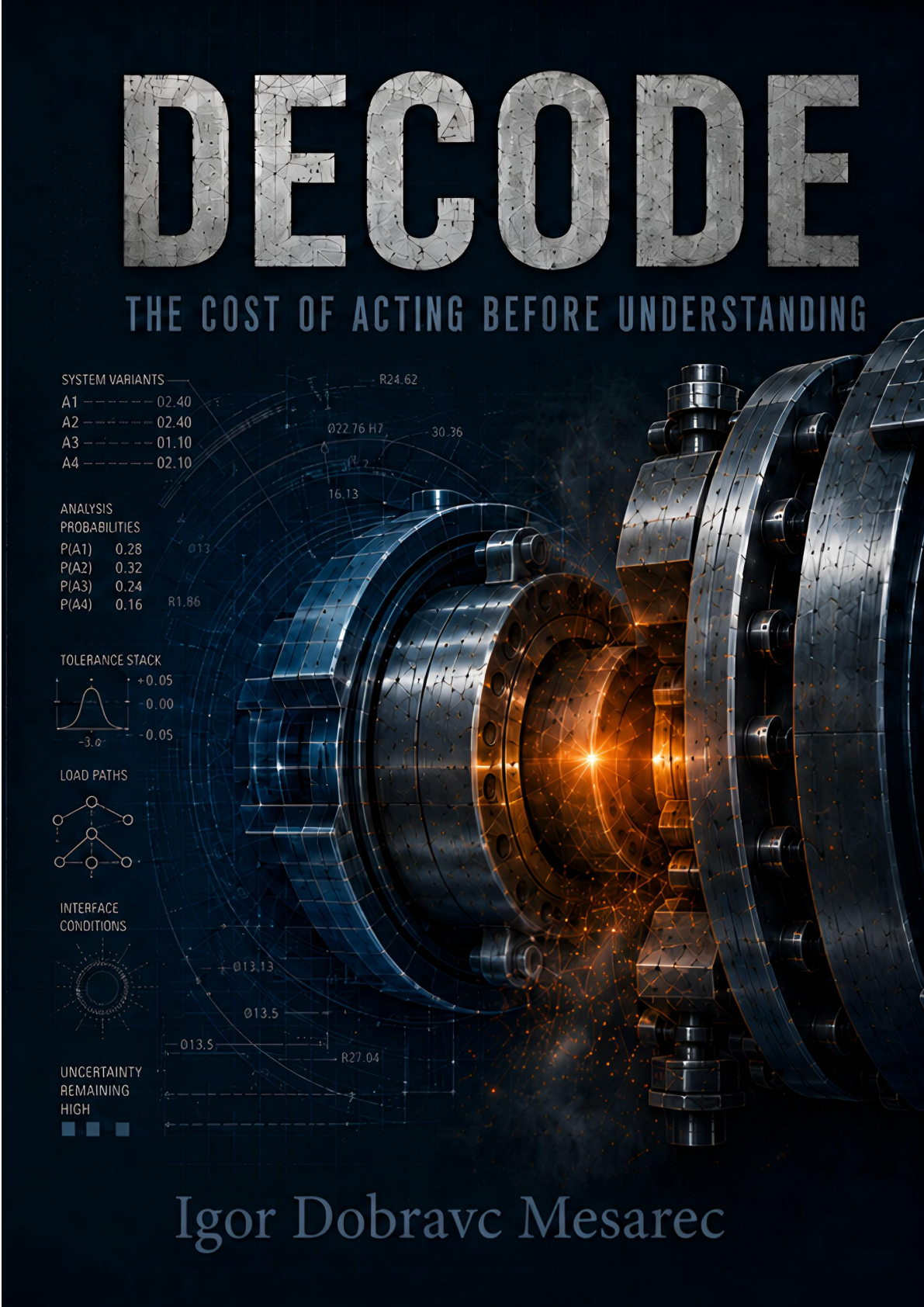
The complete book, online
Every chapter, the afterword, and all nine practical appendices are available as native, searchable web pages.
Choose a PDF or print edition →Official resources
The full official digital edition, 20 chapters and practical appendices.
Read online →02 / Structured overviewThe formal logic, positioning, A3 canvas, and responsible application of the method.
Explore →03 / Working surfaceA structured page for system scope, evidence, causal logic, decision, and closure.
Open canvas →The goal is not to slow work down.