Part Appendix · Practical Tools
Appendix BThe DECODE Canvas (Annotated for Humans)
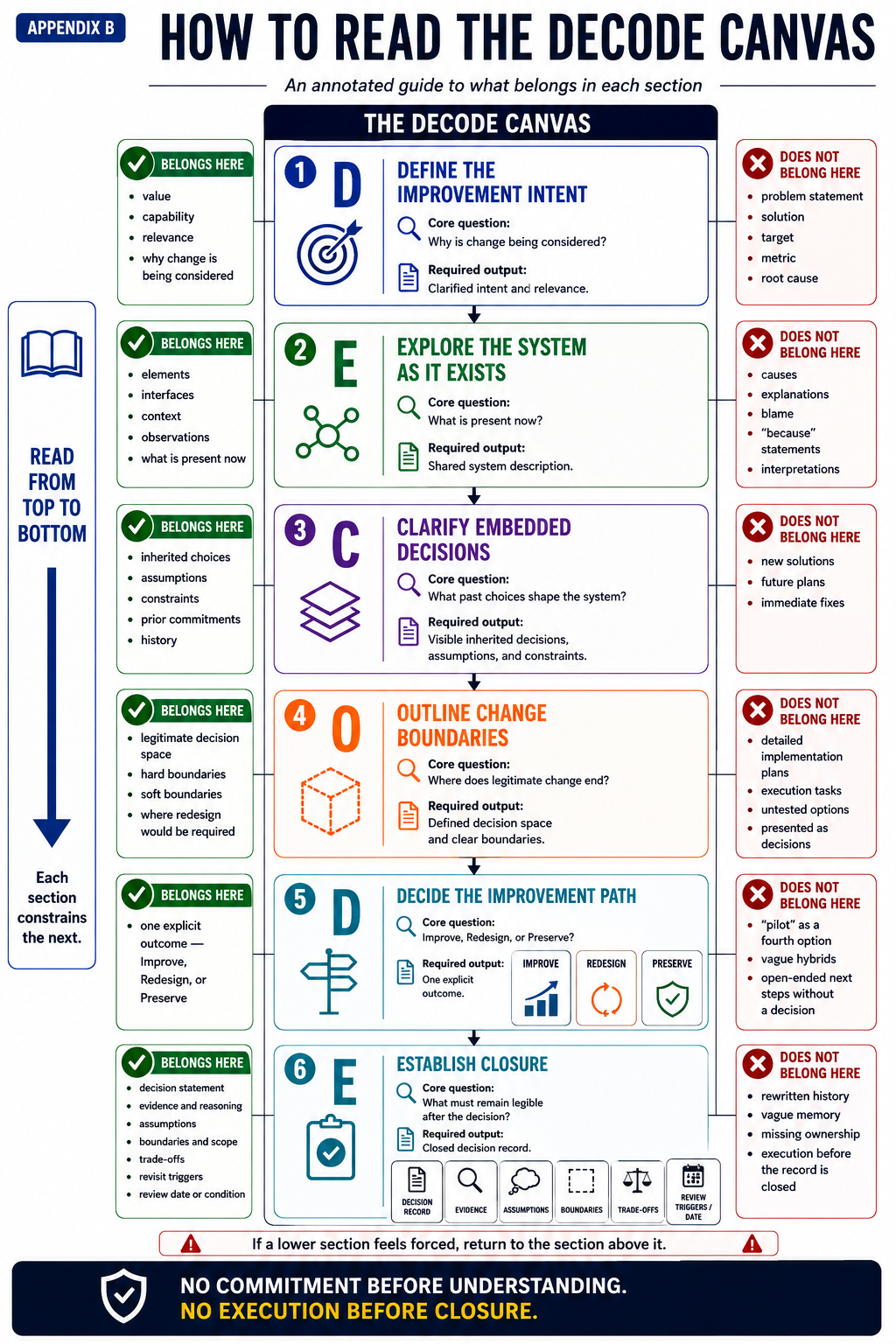
The DECODE Canvas (Annotated for Humans)#
The DECODE Canvas is not a report. It is a thinking surface. Its purpose is to slow commitment long enough for understanding to stabilize. If it ever feels like paperwork, it is being used incorrectly. This appendix explains what each section of the DECODE Canvas is for, what belongs there, and what does not.
What the DECODE Canvas Is#
The DECODE Canvas is a single-page working document that captures the reasoning behind a decision at the moment it is made. It exists to:
- Make thinking visible
- Prevent premature commitment
- Preserve reasoning over time It does not exist to:
- Generate solutions
- Document execution
- Prove compliance If the Canvas is completed after the decision is already emotionally settled, it has failed.
How to Read the Canvas#
Read the Canvas from top to bottom. Each section constrains the next. Skipping ahead weakens everything below it. If a lower section feels forced, the problem is almost always above it.
D Define the Improvement Intent#
Why are we even considering change? This section anchors relevance. What belongs here:
- The value, capability, or risk that makes change worth considering
- The reason the current state may no longer be acceptable What does not belong here:
- Problems
- Causes
- Solutions
- Targets or KPIs A good intent:
- Is directional, not prescriptive
- Creates space rather than narrowing it
- Feels slightly uncomfortable If this reads like a problem statement, the decision has already collapsed.
E Explore the System as It Exists#
What does the system actually look like right now? This section anchors reality. What belongs here:
- Description of elements, interfaces, and context
- Observations that multiple people can verify What does not belong here:
- Explanations
- Judgments
- The word “because” If this section contains causes, the next sections will be biased. Disagreement here is expected. It signals incomplete shared understanding.
C Clarify Embedded Decisions#
Which past decisions shaped what we see? This section restores agency. What belongs here:
- Design choices
- Structural decisions
- Legacy constraints
- Inherited assumptions What does not belong here:
- Defense of history
- Blame
- “That’s just how it is” This section often feels political. That discomfort means hidden decisions are becoming visible.
O Outline Change Boundaries#
Where does change become unsafe or invalid? This section protects realism. What belongs here:
- Physical limits
- Regulatory or compliance limits
- Organizational or capability limits What does not belong here:
- Preferences disguised as constraints
- Assumptions treated as facts Boundaries should eliminate options. If nothing is ruled out, this section is weak.
D Decide the Improvement Path#
What do we commit to, given what we now understand? This section creates commitment. Only three outcomes are valid:
- Improve within existing boundaries
- Redesign beyond them
- Preserve and do not change These are decision paths, not detailed solutions. The specific solution is developed after closure through the appropriate downstream method. What does not belong here:
- Plans
- Milestones
- Owners
- “We’ll see” language If this decision cannot be stated clearly in two sentences, it is not ready.
E Establish Closure#
How do we protect this decision over time? This section preserves memory. What belongs here:
- Decision statement
- Supporting evidence and reasoning
- Key assumptions
- Boundaries and scope
- Accepted trade-offs
- Revisit triggers
- Review date or review condition What does not belong here:
- Execution detail
- Success metrics
- Optimism Closure does not predict outcomes. It protects reasoning.
Common Failure Patterns#
If the DECODE Canvas feels slow You are probably doing it right. If it feels obvious The decision was likely made before the DECODE Canvas. If it becomes a checklist Stop using it. If people argue about wording You are probably too late in the process.
When to Use the DECODE Canvas#
Use the DECODE Canvas when:
- Commitment is costly to reverse
- Understanding is incomplete
- Pressure to act is high Do not use it:
- For low-risk, reversible actions
- For execution problems
- To justify decisions already made Selective use is maturity.
Final Note#
The DECODE Canvas is scaffolding. As discipline matures, teams will rely on it less visibly. The logic remains even when the page disappears. If the Canvas helps you decide less often but more deliberately, it is working. That is all it is meant to do.
The DECODE Canvas may be laid out in an A3-style one-page format. A3 describes the format, not a separate DECODE tool; the canonical working document remains the DECODE Canvas. The exact layout is intentionally left undefined.