Part Appendix · Practical Tools
Appendix EOpening Scripts (Variants)
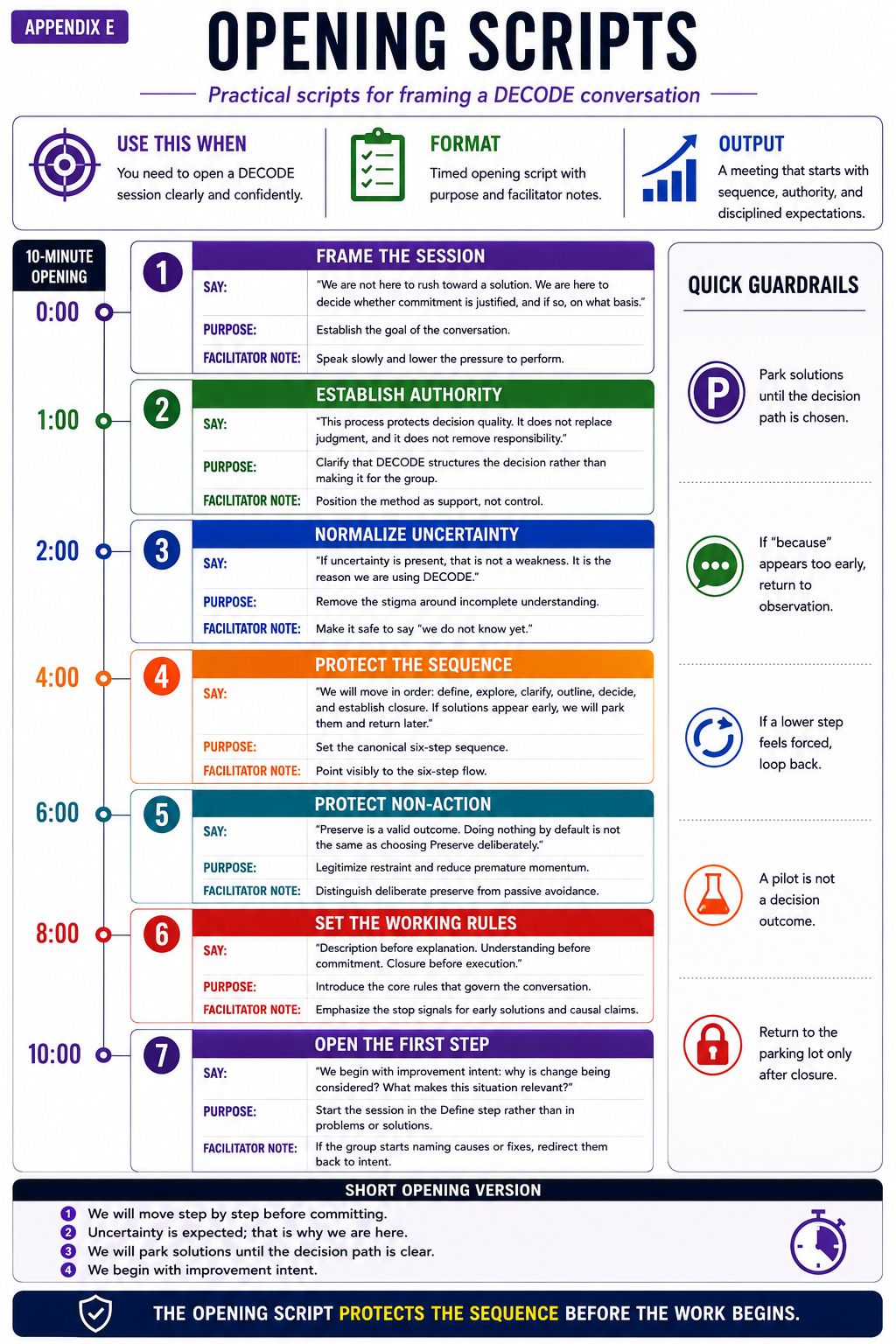
10-Minute DECODE Meeting Opening Script#
Minute 0 to 1 Frame the meeting “Before we start, I want to be clear about what this meeting is and what it is not. This is not an execution update. It is not a solution review. It is not a forum to defend work already done. This meeting exists to decide whether commitment is justified, and if so, to what extent.” Pause. “The most expensive mistakes we make usually come from committing too early, not from executing too slowly. Today is about protecting decision quality before momentum takes over.”
Minute 1 to 2 Set authority and permission “I will be actively managing the discussion. I will slow us down when we rush. I will stop us if we jump to solutions. I may pause the meeting if understanding is incomplete. Pausing without a decision today is acceptable if understanding is insufficient.” Pause. “If that feels uncomfortable, that is expected. It usually means we are working on the right kind of decision.”
Minute 2 to 3 Set behavioral rules “Three ground rules. First, disagreement is useful here. If we all agree too quickly, we are probably skipping something. Second, we will separate understanding from action. Solutions will come later, if at all. Third, clarity matters more than speed. We are not rewarded for moving fast in the wrong direction.” Pause. “If anyone feels we are violating these rules, say so.”
Minute 3 to 4 Define success for the meeting “ At the end of this meeting, one of three things should be true. We will decide to improve within the current system. We will decide to redesign beyond it. Or we will decide to preserve and not change. If we cannot clearly state one of these in two sentences, we are not ready to commit.” Pause. “Execution planning is explicitly out of scope until a decision is closed.”
Minute 4 to 5 Introduce DECODE logic briefly “We will follow a simple logic. First, we clarify why change is even worth considering. Then we look at the system as it actually exists. Then we surface the decisions already embedded in it. Then we define boundaries we cannot cross. Only then do we decide. And once we decide, we close.” Pause. “This order matters. Skipping ahead weakens the decision even if the outcome looks attractive.”
Minute 5 to 6 Name the risk explicitly “The risk today is not that we miss an opportunity. The risk is that we accidentally commit without realizing it. That resources, expectations, or credibility get spent before we agree why and how. My job today is to prevent accidental commitment.” Pause. “If you feel momentum building without clarity, that is the moment to slow down, not speed up.”
Minute 6 to 7 Address senior pressure “I know there is pressure to move. I also know that choosing not to act, or choosing to pause, can feel uncomfortable at this level. Today, restraint is not a lack of leadership. It is part of leadership.” Pause. “If we decide to act, it will be deliberate. If we decide not to, that decision will be explicit and defensible.”
Minute 7 to 8 Clarify facilitator interventions “You may hear me interrupt with questions like: Why are we considering change? What are we observing versus interpreting? Which past decisions shaped this? Where does this become unsafe? Those interruptions are not criticism. They are guardrails.” Pause. “If I stop the discussion, it is to protect the decision, not to block progress.”
Minute 8 to 9 Set tone for discomfort “This process may feel slower than usual. That is intentional. Ten minutes of discomfort here is cheaper than ten months of explaining later why something didn’t work.” Pause. “If at any point this feels frustrating, that is useful information. It usually means we are close to an assumption or boundary that matters.”
Minute 9 to 10 Transition into Chapter 8 logic “Let’s begin with the first question. Why are we even considering change? Not what is wrong. Not what we could do. Why this is worth disturbing the system at all.” Pause. “I will stop us if we drift. Let’s take this step seriously.”
10-Minute DECODE Opening Script / Complex Product and Engineering Decisions Minute 0 to 1 Set the engineering frame “Before we start, I want to set the frame for this discussion. This is not a design review. It is not a problem-solving session. It is not an execution planning meeting. This meeting exists to decide whether we should commit to a product change at all.” Pause. “In complex products, much of the cost, risk, and quality is locked in before we build anything. Today is about that moment.”
Minute 1 to 2 Name the real risk “The biggest risk here is not that we design this badly. The biggest risk is that we commit to an architecture, material, or tolerance path before we fully understand what it will lock in.” Pause. “Once we commit, learning becomes expensive.”
Minute 2 to 3 Set facilitation authority “I will actively manage the discussion. I will stop us if we jump to solutions or designs too early. I will slow us down if explanations replace observation. I may pause the meeting if understanding is not stable. Not committing today is acceptable if understanding is insufficient.” Pause. “If that feels uncomfortable, that’s normal. It usually means we are in the right space.”
Minute 3 to 4 Define what success looks like “ At the end of this discussion, one of three things should be clear. We commit to improve within the current product architecture. We commit to redesign beyond it. Or we explicitly decide to preserve the current product.” Pause. “If we can’t state that clearly, we’re not ready to commit.”
Minute 4 to 5 Introduce DECODE logic in engineering terms “We will follow a simple logic. First, we clarify why change to this product is worth considering. Then we describe the product and system as they actually exist. Then we surface the design decisions already embedded in it. Then we define boundaries we cannot cross safely or responsibly. Only then do we decide.” Pause. “The order matters. Skipping ahead locks us in early.”
Minute 5 to 6 Address expert behavior explicitly “I know many of us see patterns immediately. Experience is valuable here. It’s also dangerous. For this discussion, we will describe before we explain. If we start explaining too early, I’ll stop us.” Pause. “If you hear me interrupt, it’s to protect the decision, not to challenge expertise.”
Minute 6 to 7 Normalize disagreement “If we disagree today, that’s not a problem. Disagreement at this stage is cheap. Agreement that comes too early is expensive.” Pause. “I’m less worried if we disagree than if we align too quickly.”
Minute 7 to 8 Call out hidden pressure “There may be pressure to move because of schedules, cost targets, or downstream commitments. Those pressures are real. They are not reasons to decide.” Pause. “Today we’re deciding what deserves commitment, not what’s convenient.”
Minute 8 to 9 Set pause and loop rules “If we realize understanding is incomplete, we will pause. If something invalidates earlier framing, we will loop back. Neither of those is a failures. They’re cheaper than redesign later.”
Minute 9 to 10 Transition to intent “Let’s start with the first question. Why are we even considering change to this product? Not what is wrong. Not what we could build. Why disturbing the current product is justified.” Pause. “I will stop us if we drift. Let’s take this step seriously.”
10-Minute DECODE Opening Script / Capital Investment and M&A Decisions Minute 0 to 1 Frame the gravity “Before we begin, I want to set the frame for this discussion. Capital and acquisition decisions are different from operating decisions. Once we commit, reversal is slow, expensive, and often reputationally damaging. This meeting exists to decide whether commitment is justified. Not how to execute it. Not how to make it work once we’ve decided.” Pause. “Our biggest risk today is not missing upside. It is committing to something we later struggle to explain.”
Minute 1 to 2 Explicitly suspend momentum “There is already momentum around this topic. There are numbers, models, opinions, and probably preferred outcomes in the room. That is normal. For the next part of this meeting, we are suspending momentum. We are not here to defend work already done.” Pause. “If we decide to proceed later, that work will matter. Right now, our responsibility is to decide whether proceeding is justified at all.”
Minute 2 to 3 Set authority and permission “I will actively manage this discussion. I will interrupt if we jump to structure, valuation, or integration details too early. I will slow us down if conclusions form before understanding stabilizes. I may pause the meeting if the basis for commitment is unclear. Choosing Preserve is a valid decision outcome. Pausing is also acceptable when understanding is insufficient.” Pause. “ At this scale, restraint is not indecision. It is governance.”
Minute 3 to 4 Define decision success “ At the end of this discussion, one of three things should be true. We commit to proceed. We commit to redesign the opportunity. Or we commit to not proceed. If we cannot state that commitment clearly and defensibly in two sentences, we are not ready.” Pause. “Conditional enthusiasm is not a decision.”
Minute 4 to 5 Introduce DECODE logic in investment terms “We will follow a simple decision logic. First, we clarify why this investment or acquisition is worth considering now. Then we look at the system we would be entering as it actually exists. Then we surface the decisions already embedded in it, including legacy risks.
Then we define boundaries we cannot cross, financially, legally, or strategically. Only then do we decide whether to commit.” Pause. “This order protects us from falling in love with structure before relevance is proven.”
Minute 5 to 6 Name the typical failure mode “Most failed investments do not fail because execution was sloppy. They fail because assumptions were embedded too early, boundaries were discovered too late, or intent was retrofitted after the fact.” Pause. “Today is about making those things explicit before we commit capital or reputation.”
Minute 6 to 7 Address valuation pressure directly “There will be pressure to discuss valuation, synergies, and timelines. Those conversations matter. They do not belong at the front of this discussion. Valuation assumes relevance. Synergies assume integration feasibility. Timelines assume commitment. We will get there only if the decision deserves it.”
Minute 7 to 8 Clarify facilitator interventions “You may hear me interrupt with questions like: Why is this investment worth considering now? What are we observing versus assuming about the target? Which historical decisions shape this opportunity? Where does this become unsafe or irreversible? Those interruptions are deliberate. They protect us from accidental commitment.” Pause. “If this feels restrictive, it means the discipline is working.”
Minute 8 to 9 Normalize disagreement and dissent “If there is disagreement in the room, that is not a problem. Disagreement here is cheaper than disagreement after signing. Silence today is expensive later.” Pause. “I expect differences in perspective. I do not expect forced alignment.”
Minute 9 to 10 Transition into intent “Let’s begin with the first and most important question. Why are we even considering this investment or acquisition now? Not the structure. Not the valuation. Not the deal mechanics. Why disturbing our capital, portfolio, and focus is justified.” Pause. “If we cannot answer that clearly, everything else is noise.”
CEO Opening Script#
High-Impact Decision Discussion#
“Before we begin, I want to be clear about what we are here to do. This discussion is not about reviewing work, defending analysis, or building momentum. It is about deciding whether we should commit, and if so, to what extent.” Pause. “We are operating under uncertainty. That is normal. What matters today is not certainty, but whether our understanding is strong enough to justify commitment.” Pause. “I want to be explicit about something. Choosing Preserve is a valid decision outcome. Choosing to pause is also acceptable when understanding is insufficient. It is not a failure of leadership. In many cases, it is leadership.” Pause. “Our biggest risk in discussions like this is accidental commitment. That happens when we let activity, enthusiasm, or partial analysis substitute for a decision.” Pause. “So today, I expect us to slow down before we speed up. I expect disagreement to surface early. And I expect us to separate understanding from action.” Pause. “ At the end of this discussion, one of three things should be true. We commit to proceed. We commit to materially redesign the proposal. Or we commit to not proceed.” Pause. “If we cannot state that clearly, we are not ready to decide.” Pause. “I will help manage the discussion to keep us in that space. If I interrupt or redirect, it’s not to block progress; it’s to protect the quality of the decision.” Pause. “Let’s begin with the first question. Why is change worth considering at all?”