Part I · The Real Problem
03Why 'Doing Nothing' Feels Illegal
Why “Doing Nothing” Feels Illegal#
In many organizations, not acting is treated as a failure of leadership.
This belief is rarely written down. It does not appear in procedures, training materials, or governance documents. Yet it shapes behavior powerfully. When uncertainty increases and pressure builds, action is expected. Movement is equated with responsibility. Restraint is interpreted as hesitation. As a result, teams often act not because they understand what should be done, but because doing nothing feels unacceptable. This dynamic is one of the strongest drivers of premature commitment.
The Psychology of Forced Action#
Human beings are uncomfortable with unresolved situations. Ambiguity creates tension. It demands patience, explanation, and the admission that answers are not yet available. Action relieves that tension. Once something is being done, uncertainty feels more manageable, even if nothing meaningful has changed. Meetings become easier. Status updates become clearer. Progress can be described in terms of activity rather than understanding. In organizational settings, this psychological relief is amplified. Action creates the appearance of control. It signals competence to peers, superiors, and stakeholders. It reassures others that the situation is being handled. Doing nothing offers none of these signals. As a result, action is often chosen not because it is justified, but because it is emotionally stabilizing.
Visibility Bias#
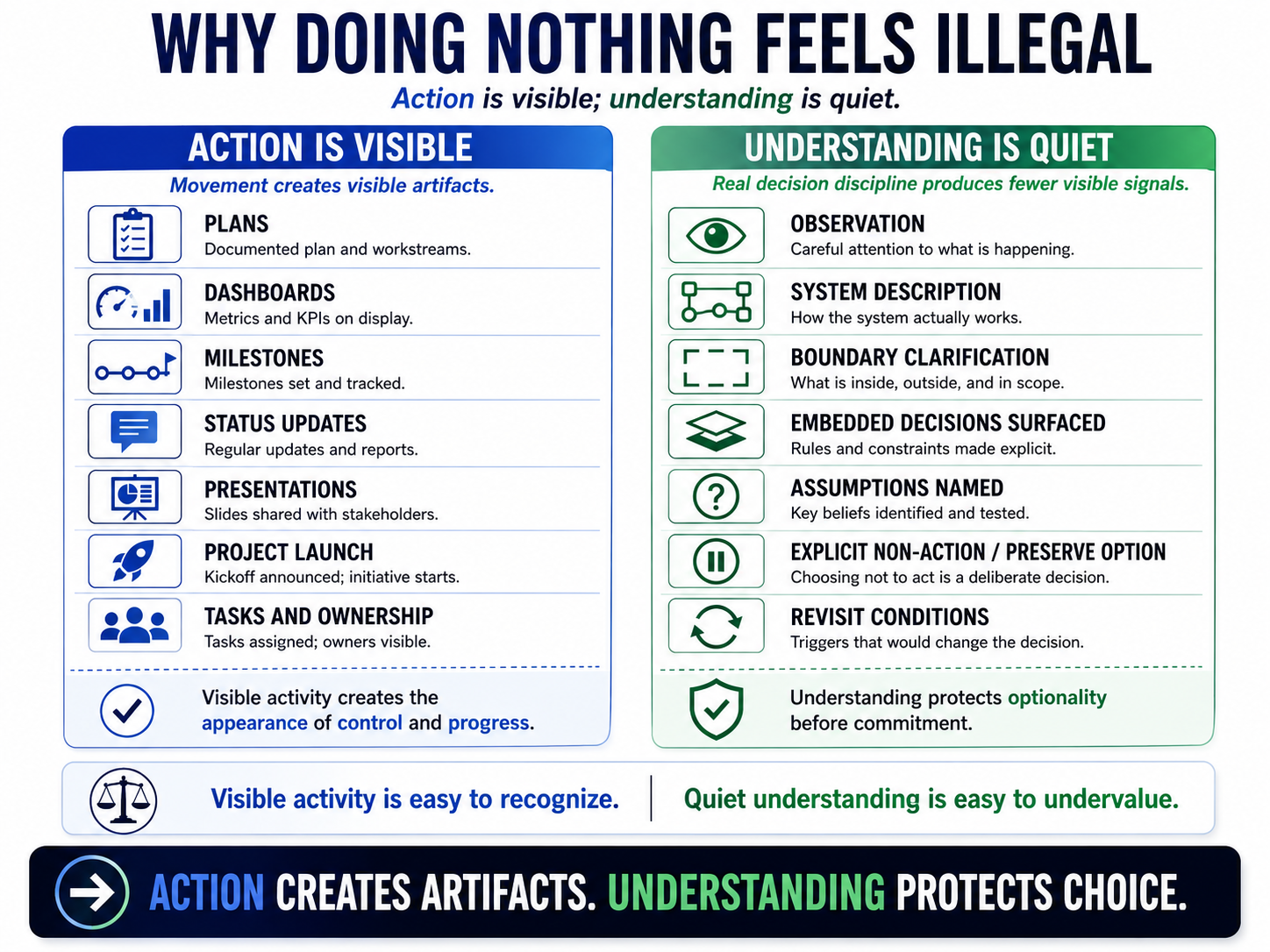
One reason non-action feels illegitimate is that it is largely invisible. Action produces artifacts. Plans, timelines, presentations, prototypes, and dashboards all make effort visible. They provide evidence that work is happening and that responsibility is being exercised. Understanding, by contrast, is harder to see. Observation, boundary clarification, and the reconstruction of embedded decisions produce fewer tangible outputs. Their value is real, but indirect. In environments that reward visible progress, this creates a bias. What can be seen is valued. What cannot be seen is questioned.
Over time, organizations learn to equate visibility with contribution. This makes restraint risky. A leader who pauses to understand must explain that pause repeatedly. A leader who launches an initiative rarely has to justify movement itself. This asymmetry quietly pushes decisions toward action.
Leadership Pressure#
Pressure to act is often strongest at leadership levels. Leaders are expected to decide. They are rewarded for confidence. They are evaluated on momentum and results. Admitting that a situation is not yet understood can feel like admitting a lack of control. This creates a subtle trap. Leaders may feel compelled to choose a direction even when the information required to justify that choice is incomplete. Once a direction is announced, it becomes difficult to reverse without loss of credibility. In these conditions, action becomes a way to protect authority rather than to serve understanding. This is not a failure of character. It is a predictable response to the expectations placed on decision-makers.
Why Restraint Looks Like Incompetence#
Restraint is often misinterpreted because it looks similar to indecision. From the outside, choosing not to act can appear passive. Without explicit framing, it is difficult to distinguish disciplined non-action from avoidance, fear, or lack of initiative. Most organizations lack a language for intentional restraint. They have many ways to describe action, but few ways to describe the decision not to act. As a result, restraint must be defended repeatedly, while action is assumed to be legitimate by default. This imbalance creates a powerful incentive to move forward, even when understanding is incomplete.
The Cost of Suppressing Non-Action#
When non-action is treated as illegitimate, organizations lose an important decision option. They become less capable of waiting for evidence. Less willing to explore boundaries. Less comfortable acknowledging uncertainty. Over time, this narrows the decision space. Every situation becomes framed as requiring intervention. Preservation is rarely considered. Delay is equated with failure. This bias does not eliminate uncertainty. It hides uncertainty inside confident actions.
Reframing Non-Action#
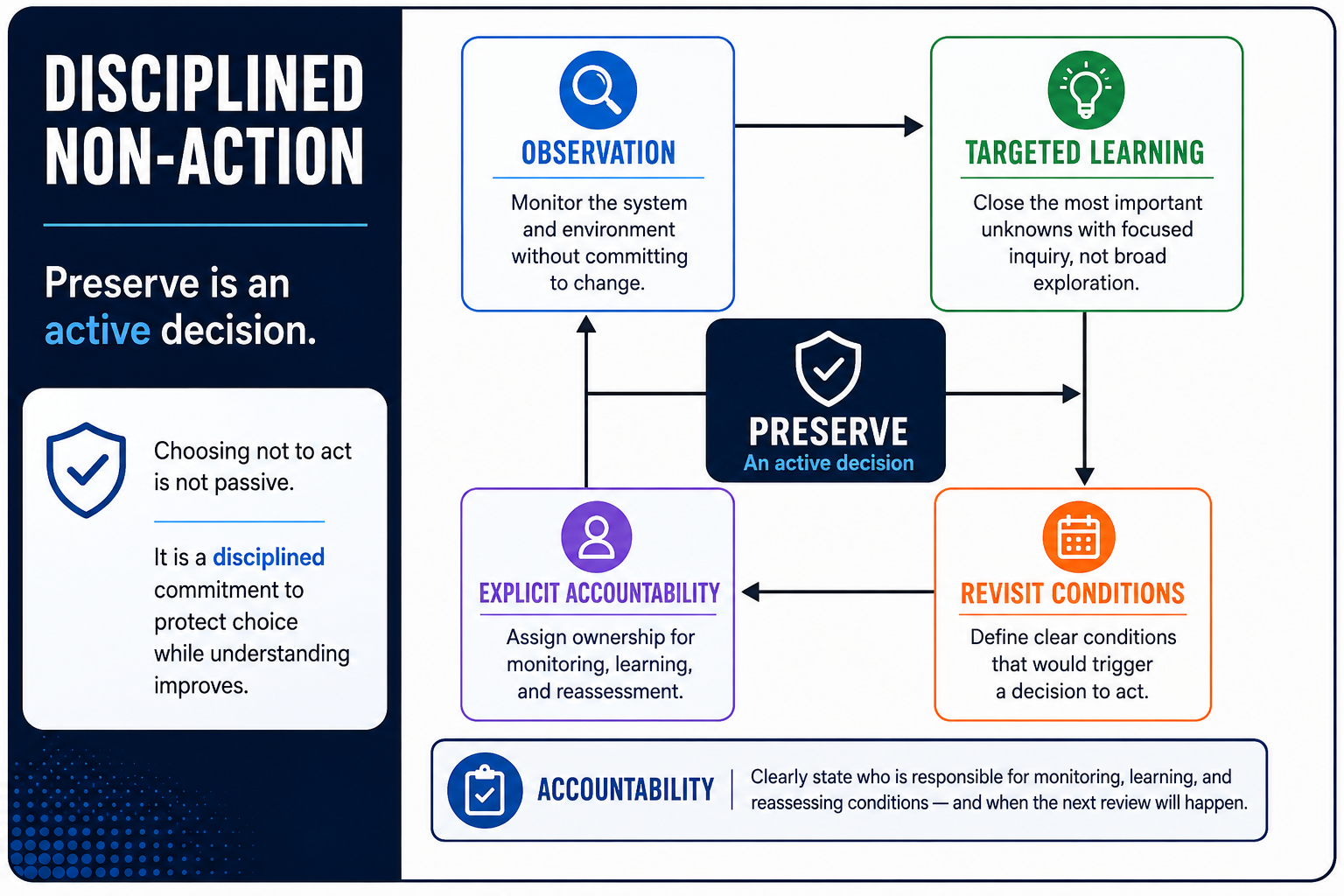
Non-action can be a disciplined decision. In decision problems, choosing not to act can be the most responsible outcome available. This does not mean ignoring the situation. It means explicitly deciding to preserve the current state while conditions are clarified. Disciplined non -action includes continued observation, targeted learning, boundary clarification, and explicit revisit conditions. What distinguishes it from avoidance is that it is intentional, justified, and reviewable. Execution problems do not allow this option. Decision problems often require it. Recognizing non-action as a legitimate decision expands an organization’s ability to manage risk under uncertainty.
What to Do When the Pressure Appears#
Pressure to act rarely announces itself directly. It shows up as impatience, urgency, or a demand for clarity before clarity exists. In those moments, leaders often feel compelled to choose a direction simply to restore order. One effective response is not to argue for delay, but to reframe what responsibility looks like. Instead of saying, “We are not ready to decide,” say, “ We are deciding what we need to understand before committing.” Instead of saying, “We should wait,” say, “We are choosing not to commit until the situation is clearer.”
Instead of defending non-action, name it explicitly as the decision being made. This shifts the conversation. The issue is no longer speed versus hesitation. It becomes responsibility versus assumption. Restraint only looks like indecision when it is not framed as a deliberate choice. Naming non-action as a decision removes the stigma that usually forces premature commitment.
Key Takeaway#
Action is visible. Understanding is quiet. When organizations reward visibility without discipline, they bias decisions toward premature commitment. Treating non-action as a legitimate outcome is not a retreat from leadership. It is an act of responsibility when understanding is still forming. The next chapter introduces the discipline designed to support this behavior. Before action can be chosen responsibly, understanding must be built deliberately. That logic is where DECODE begins.