Part Appendix · Practical Tools
Appendix GWhen a Decision Should Not See DECODE
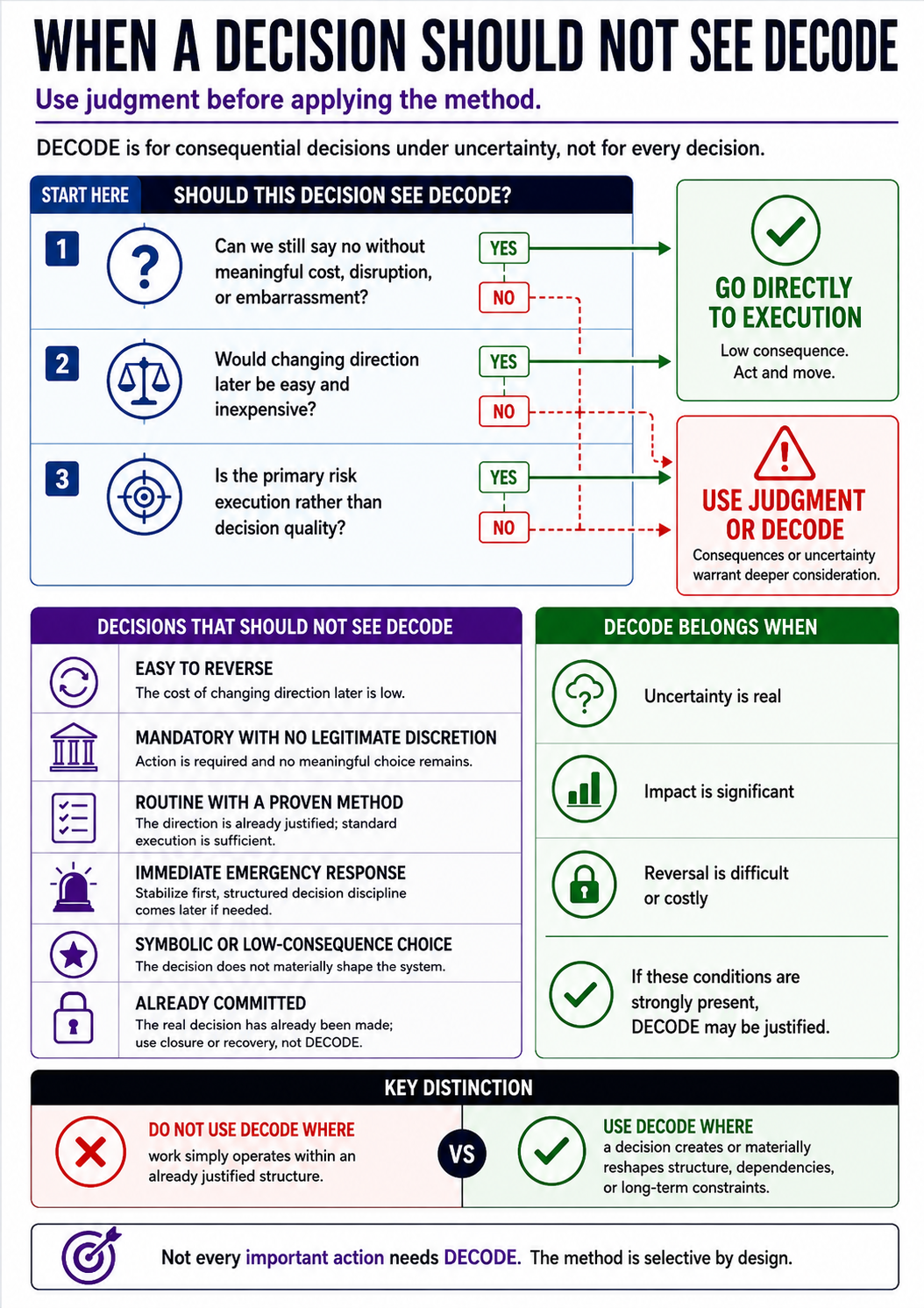
When a Decision Should Not See DECODE#
DECODE is designed for decisions that create or materially reshape structure, dependencies, or long- term constraints. It should not be applied simply because a decision feels important, visible, or difficult. Some decisions are better handled through action, established procedure, direct compliance, or immediate response. The categories below clarify when formal DECODE is unnecessary or inappropriate.
1. Easy to Reverse#
If a decision can be reversed quickly, cheaply, and without meaningful structural consequences, formal DECODE is usually unnecessary. Examples include:
- A small experiment that can be stopped without disruption
- A temporary configuration change with an easy rollback
- A low-cost pilot with no lasting dependency
- A short-term working arrangement that creates no durable commitment The important question is not whether the decision contains uncertainty. It is whether learning through action is cheaper than resolving that uncertainty in advance. Rule: If reversal is cheap and clean, learn through action.
2. Mandatory With No Discretion#
DECODE is not useful when the organization has no meaningful choice to make. Examples include:
- A legal or regulatory requirement
- A mandatory safety control
- A court or authority directive
- A contractual obligation whose relevant terms are already fixed
- A required corporate policy with no local discretion There may still be decisions about how the requirement is implemented. Those implementation decisions can be assessed separately. But the mandated decision itself should not be presented as open when it is not. Rule: Do not pretend to decide what has already been decided for you.
3. Routine With a Proven Method#
Some decisions occur repeatedly within a stable structure and already have a reliable method for resolving them. Examples include:
- Standard operational scheduling
- Routine maintenance decisions
- Established quality-control responses
- Repeated purchasing within approved thresholds
- Known incident handling with a tested procedure In these situations, the important risk is usually execution variance rather than decision quality. Adding DECODE would duplicate an already justified method. This exemption applies only while the underlying structure and assumptions remain valid. If the routine begins to expose a structural problem, the decision may need to be reconsidered. Rule: When a proven method already governs the decision, use the proven method.
4. Immediate Emergency Response#
When delay creates greater danger than imperfect action, the full DECODE process should not stand between the organization and an immediate response. Examples include:
- Protecting people during a safety incident
- Containing an active cyberattack
- Stabilizing a critical operational failure
- Responding to an immediate threat to continuity
- Taking urgent action to prevent major loss or harm Emergency response does not eliminate decision discipline. It compresses it. Teams should make the minimum necessary decision, state the risks being accepted where possible, and preserve enough reasoning for later review. An abbreviated DECODE review may be useful when circumstances allow, but the full method should not delay essential action. Rule: When delay creates the greater risk, stabilize first and review afterward.
5. Symbolic or Low-Consequence#
Formal DECODE is unnecessary when a decision has little structural consequence, creates no meaningful dependency, and does not materially constrain future choices. Examples include:
- A reversible naming choice
- A minor presentation preference
- A low-impact ceremonial decision
- A temporary internal convention
- A symbolic choice with no material operational effect Visibility should not be confused with structural significance. A decision can attract attention without meaningfully changing how the system works. Likewise, a financially small decision may still deserve DECODE if it changes control, dependencies, boundaries, or future options. Rule: Use DECODE according to structural consequence, not visibility or apparent importance.
6. Already Committed#
DECODE should not be used to manufacture justification after a decision has effectively been made. Examples include:
- Leadership has already communicated the decision as final
- Resources have already been irreversibly committed
- An external commitment has removed realistic alternatives
- The organization has already begun implementation beyond a credible point of reversal
- The exercise is being used only to validate a preferred answer At this stage, DECODE cannot improve the formation of the original decision because the decision is no longer genuinely open. The appropriate task may instead be to document the existing commitment, assess consequences, manage execution, or determine whether reopening the decision is possible. Rule: Never use DECODE to rationalize a decision that is no longer open.
Decisions That Look Small but Still Need DECODE#
Apparent size does not determine whether DECODE is appropriate. A seemingly small decision may still require formal treatment when it:
- Changes ownership or decision rights
- Alters governance or accountability
- Creates a new dependency
- Narrows future options
- Changes an important boundary
- Introduces a durable technical or operational constraint
- Creates a difficult-to-reverse commitment Size does not determine decision risk. Structure does.
Practical Gating Test#
Before applying formal DECODE, ask: 1. Is the decision genuinely open? 2. Would reversing it later be cheap and straightforward? 3. Does an already justified and proven method govern this type of decision? 4. Would taking time for formal DECODE create greater immediate risk than acting? 5. Does the decision materially affect structure, dependencies, or long-term constraints? If the decision is easy to reverse, mandatory, routine under a proven method, an immediate emergency response, symbolic or low-consequence, or already committed, formal DECODE may not be appropriate. If the decision materially creates or reshapes structure, dependencies, boundaries, authority, or long- term constraints, DECODE should be considered even when the decision appears small.
Final Principle#
DECODE should be used selectively. It is not required for every decision, and using it where no meaningful decision exists adds ceremony without improving judgment. Its value is greatest where commitment matters, reversal is difficult, and the decision will shape what becomes possible afterward. Use DECODE when decision quality matters before commitment. Use simpler methods when the structure is already justified and the work does not materially change it. Selective use is not a weakness of the method. It is part of the discipline.