Part Appendix · Practical Tools
Appendix HEnd-to-End DECODE Example
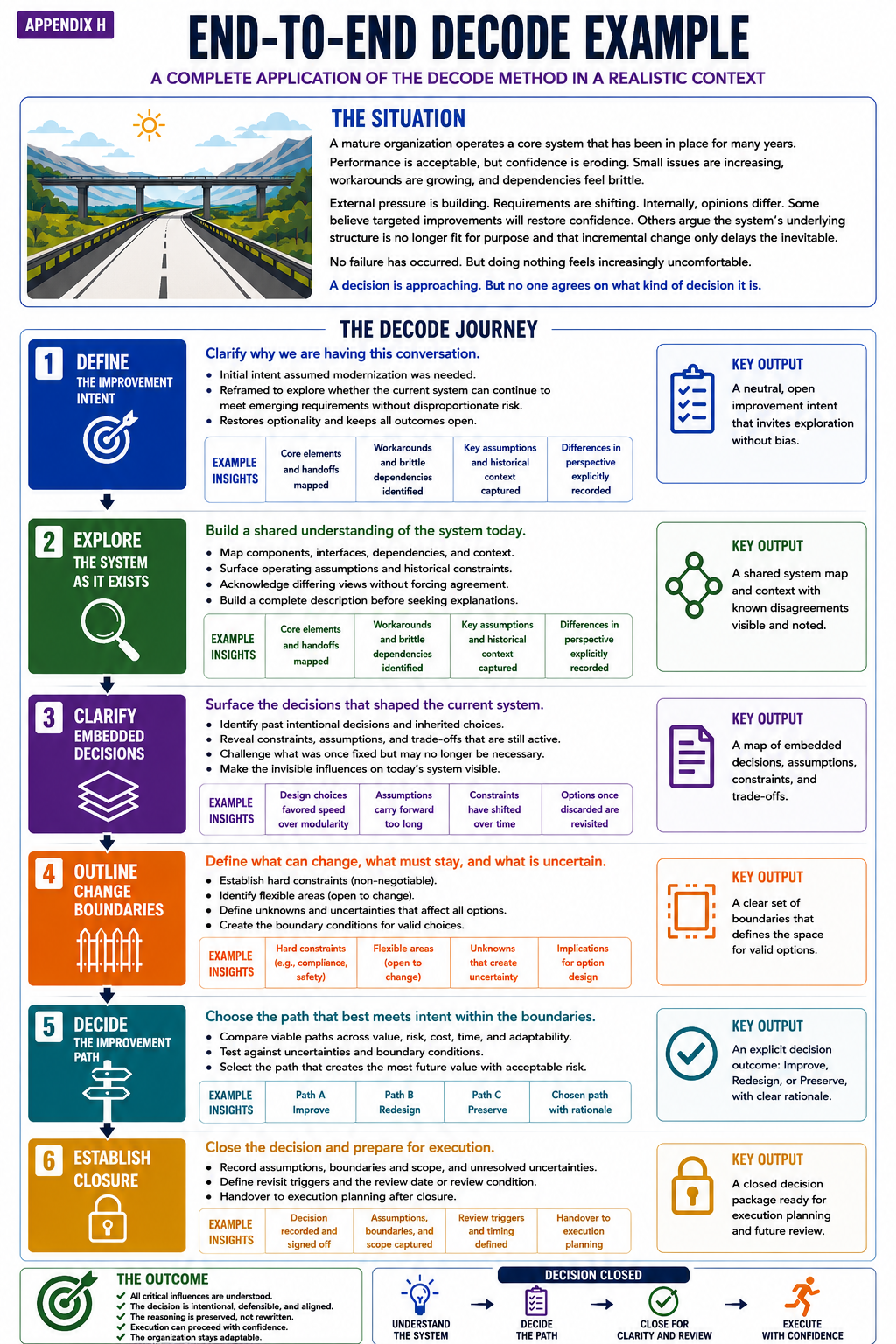
The Situation#
A mature organization operates a core system that has been in place for many years. Performance metrics remain within acceptable ranges, but confidence in the system is eroding. Small issues appear more frequently. Workarounds are increasing. Dependencies that were once manageable now feel brittle. External pressure is building. Market expectations are shifting. New requirements are emerging slowly rather than through a single disruptive event. Internally, opinions differ. Some believe targeted improvements will restore confidence. Others argue that the system’s underlying structure is no longer fit for purpose and that incremental change only delays the inevitable. No failure has occurred. No crisis demands immediate action. At the same time, doing nothing feels increasingly uncomfortable. The organization senses that a decision is approaching but does not yet agree on what kind of decision it is. Understanding is partial. Signals are mixed. Momentum to act is present, but justification is not yet clear.
Step 1#
Define the Improvement Intent#
The initial intent proposed in the discussion is framed as: “Modernize the system to reduce risk and improve performance.” This intent fails quietly. It already assumes both a problem and a direction. It collapses exploration into action by implying that modernization is necessary and desirable. After discussion, the intent is reframed as: “Determine whether the current system can continue to meet emerging requirements without disproportionate risk to reliability, cost, or adaptability.” This intent succeeds because it restores optionality. It does not assume that change is required. It clarifies why the system is being questioned without implying how that question must be answered. The first intent failed because it smuggled a solution into the conversation. The corrected intent creates space for understanding to develop before commitment occurs.
Step 2#
Explore the System as It Exists#
The group describes the system as it exists today. They identify core elements, supporting components, and external dependencies. They describe interfaces where handovers occur and where coordination is required. Context is surfaced, including operating assumptions, historical growth, and constraints imposed by surrounding systems. One disagreement emerges early. Some participants describe the system as fundamentally stable with localized weaknesses. Others describe it as fragile, arguing that stability is an illusion maintained through informal workarounds. The disagreement is not resolved. It is noted and held. Both descriptions are plausible given the current level of understanding. Explanations are deliberately postponed. The focus remains on shared description rather than agreement.
Step 3#
Clarify Embedded Decisions#
Attention shifts to past decisions that shaped the current system. One inherited decision becomes visible: a design choice made years earlier to prioritize speed of deployment over modularity. At the time, this choice was intentional and appropriate. Its consequences were acceptable under earlier conditions. A constraint believed to be fixed begins to soften. A dependency long treated as unavoidable turns out to be the result of a historical integration choice rather than a fundamental limitation. A moment occurs when someone says, “That’s just how the system works,” and then pauses. On examination, it becomes clear that this behavior is not inherent. It is the result of accumulated decisions that were never revisited. At this point, inevitability collapses into history. The group regains agency.
Step 4#
Outline Change Boundaries#
The group defines boundaries that cannot be crossed safely or responsibly. One boundary eliminates a favored option. A popular proposal would violate regulatory constraints that are non-negotiable. This option is removed early, before further energy is invested. Another boundary reveals itself as an assumption. A perceived organizational limitation turns out to be a capability choice rather than a hard limit. Changing it would be costly, but not impossible. This distinction is uncomfortable. It forces the group to confront trade-offs directly rather than hiding behind presumed constraints. By the end of this step, the space of legitimate options is smaller but clearer.
Step 5#
Decide the Improvement Path#
With understanding stabilized, the group decides. The decision is to redesign. Improvement is rejected because it would continue to rely on structural choices that no longer align with emerging requirements. Preservation is rejected because confidence cannot be restored without addressing those structures directly. Redesign is chosen with full awareness of cost, disruption, and risk. It is selected not because it is attractive, but because it is now justified. No plans are discussed. No timelines are set. The decision stands on its reasoning alone.
Step 6#
Establish Closure#
The decision is captured explicitly. Decision statement The organization commits to redesigning the core system to address structural limitations that cannot be resolved through incremental improvement. Evidence and reasoning Performance remains within acceptable ranges, but workarounds and brittle dependencies are increasing. Improvement within the current structure would preserve structural choices that no longer align with emerging requirements. A favored alternative was eliminated because it would violate non-negotiable regulatory boundaries. Assumptions External requirements will continue to evolve rather than stabilize. Organizational capacity to absorb redesign exists if paced deliberately. Boundaries and scope Regulatory requirements remain non-negotiable. The decision authorizes redesign of the system structure, but does not select the detailed technical solution. Trade-offs accepted Near-term efficiency will decrease. Transition risk is acknowledged and accepted. Revisit triggers A material change in external requirements. Evidence that assumptions about capacity are no longer valid. Review condition Review the decision at the first formal redesign gate, or earlier if a revisit trigger occurs. The decision is now closed. Execution planning can now begin through the appropriate downstream method.
What Would Normally Have Gone Wrong#
Under normal conditions, the organization would have committed earlier. A modernization initiative would have been launched under the banner of improvement. Incremental changes would have accumulated. Dependencies would have deepened. By the time redesign became unavoidable, reversal would have been politically and technically expensive. DECODE prevented this by holding commitment long enough for the nature of the decision to become clear.
What Changed#
Nothing was fixed yet. No outcome was achieved. What changed was clarity. The organization could explain why it chose redesign. It could explain why improvement was insufficient and why preservation was rejected. It could revisit the decision without rewriting history. Restraint replaced momentum. Understanding replaced urgency. That change was enough to justify the discipline.
Closing Note#
This example is not exceptional. Most decisions that benefit from DECODE look exactly like this. No crisis. No villain. No breakthrough insight. Just a disciplined pause that prevents accidental commitment. That is what the method is for.