Part III · The DECODE Logic / The Core
10Clarify Embedded Decisions
C Clarify Embedded Decisions#
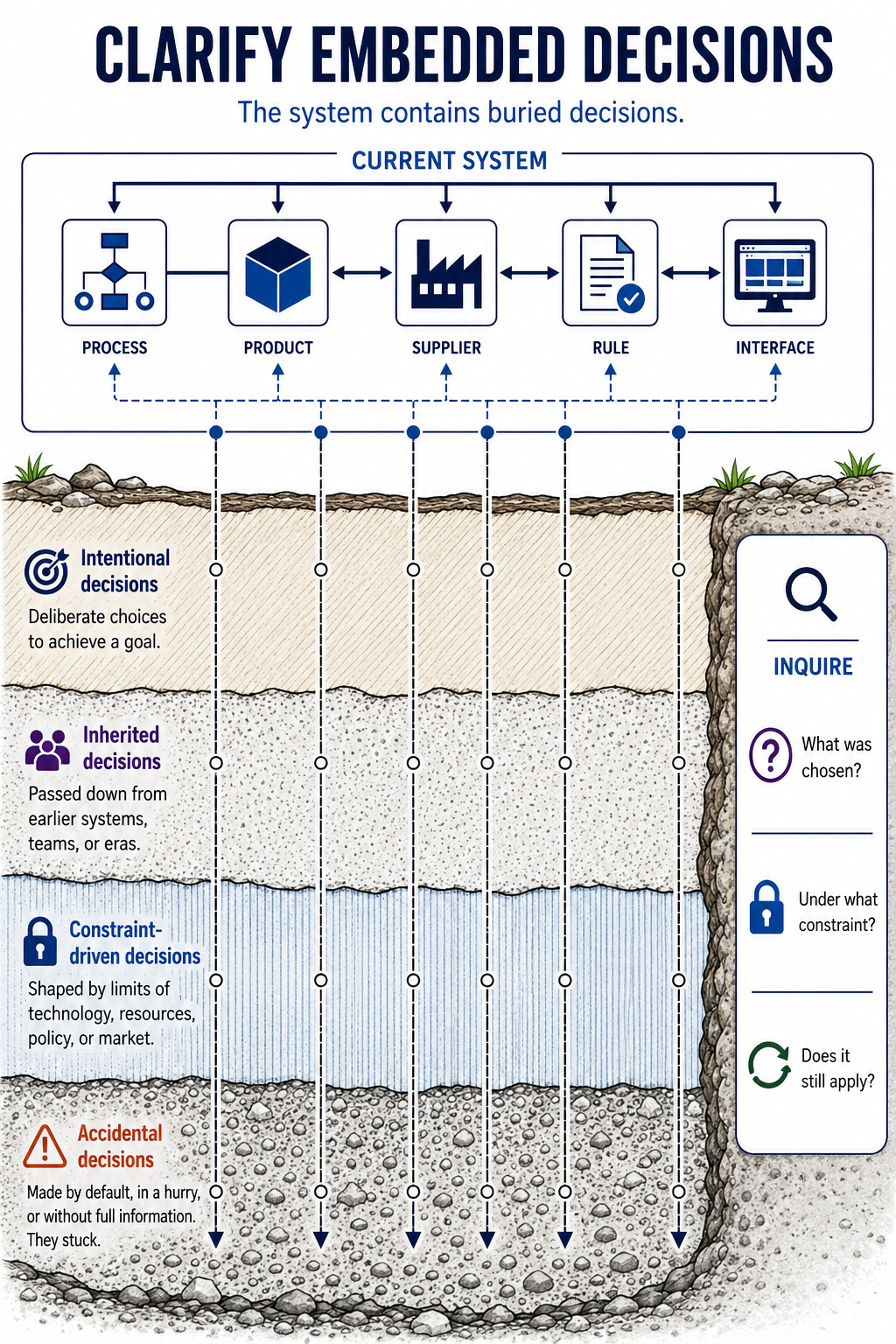
Nothing in a system is neutral, even when no one remembers deciding it. Once the system has been described as it exists, the next question is unavoidable. Why does it look this way? This step exists to surface the decisions that are already embedded in the system. Some were made deliberately. Some were inherited. Some emerged under constraint. Others resulted from shortcuts, compromises, or forgotten assumptions. Until these decisions are made explicit, the system appears inevitable.
Nothing Is Neutral#
Every system reflects past choices. Layout, process flow, tolerances, roles, interfaces, controls, and workarounds all encode decisions that were made at some point. Even the absence of change is usually the result of a decision to preserve, defer, or avoid. Neutrality is an illusion. When teams treat the current state as given rather than chosen, they mistake history for necessity. This makes change feel riskier than it actually is and limits the range of options considered. Clarifying embedded decisions restores agency.
Intentional Versus Inherited Decisions#
Some decisions were made consciously. They were debated, documented, and justified at the time. They reflect explicit trade -offs and known constraints. These decisions often still make sense, even if conditions have changed. Others were inherited. They entered the system through legacy designs, transferred practices, vendor defaults, regulatory interpretations, or past leadership preferences. Over time, they became part of how things are done without anyone actively choosing them. Inherited decisions are especially dangerous because they feel natural. They are rarely questioned, even when their original rationale no longer applies. DECODE does not assume that intentional decisions are inherently better than inherited ones. It only insists that the difference be recognized.
Excavating Embedded Decisions#
Embedded decisions are rarely documented. They are preserved through habit, structure, and repetition. Surfacing them requires looking backward before looking forward. Useful questions at this stage include the following:
- What problem was the system originally designed to solve?
- What trade-offs were accepted to make it work at the time?
- Which decisions were made under constraints that no longer apply?
- What was optimized last time the system was changed?
- Who benefits from the system in its current form? These questions are not meant to assign blame. They exist to separate necessity from history.
Constraints Versus Accidents#
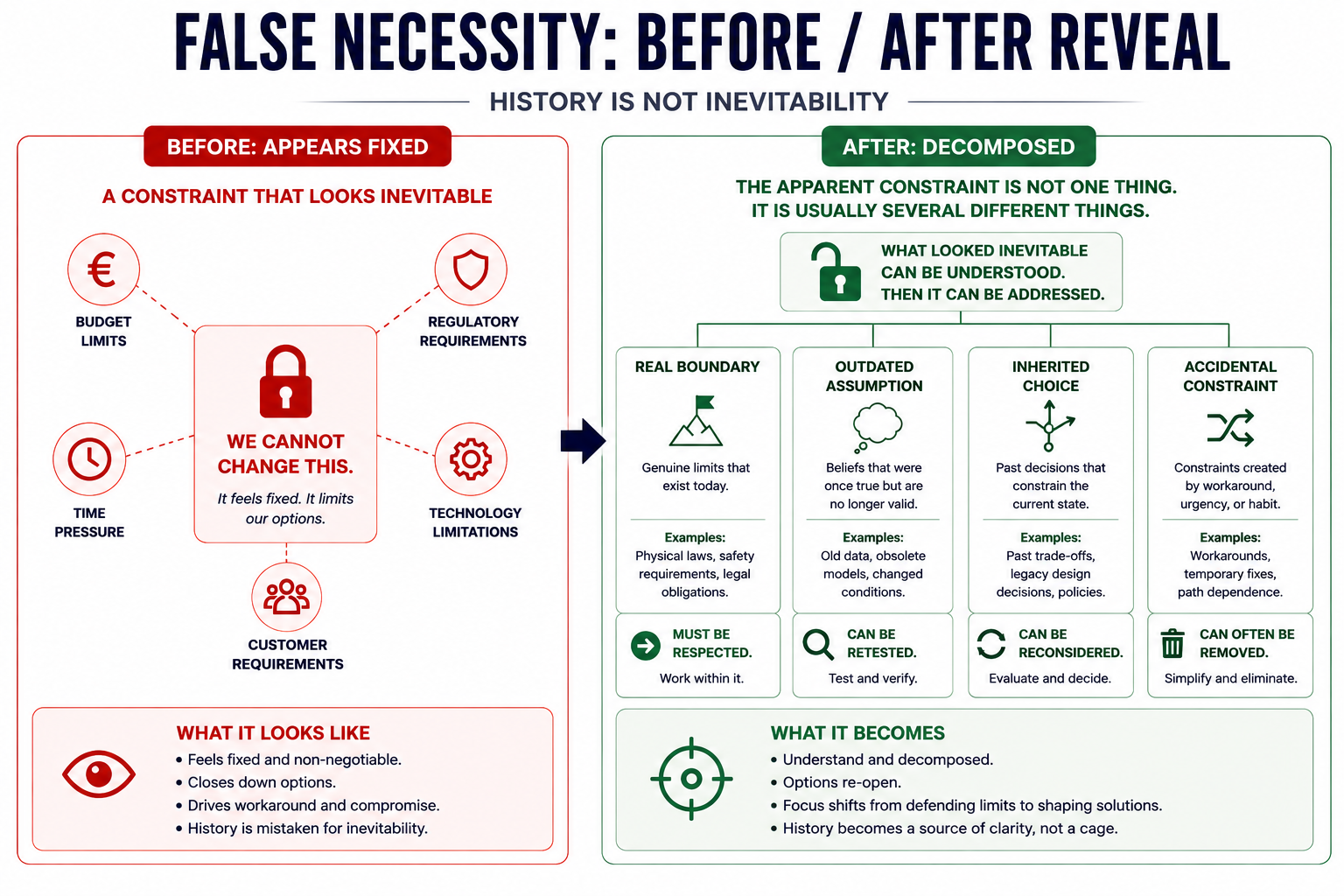
Embedded decisions often appear as constraints. Some constraints are real. Physics, safety, compliance, and irreversible investments define boundaries that cannot be crossed. These constraints must be respected. Others only look like constraints. They originated as temporary limitations, risk avoidance, resource shortages, or assumptions that were never revisited. Over time, they hardened into rules without being tested again. Accidents also leave lasting traces. Workarounds created to handle exceptions. Simplifications introduced under pressure. Short-term fixes that became permanent. These are rarely documented as decisions, but they shape behavior just as strongly. DECODE separates true constraints from historical artifacts. Without this separation, teams defend limitations that no longer exist.
Why Systems Look Inevitable#
Systems often feel inevitable because the decisions that shaped them are invisible. When causes are forgotten and alternatives are no longer imagined, the current state appears as the only possible one. Change feels disruptive not because it is risky, but because it challenges an assumed necessity. This is why experienced teams often say “This is just how it is.” What they mean is “This is how it became.” Clarifying embedded decisions breaks this illusion. It reveals where choice still exists and where it does not. It turns inevitability back into design space.
False Necessity#
False necessity occurs when something is treated as unavoidable even though it originated from a choice that could be reconsidered. This step exists to prevent that error. By reconstructing the decisions that shaped the system, DECODE allows teams to ask whether those decisions still serve the original intent. Some will. Others will not. The goal is not to undo the past. It is to stop being governed by it unconsciously. Only once false necessity is removed can real boundaries be distinguished from inherited assumptions.
How This Step Changes the Conversation#
When embedded decisions are clarified, the nature of discussion shifts. Debates move from opinions to history. Resistance becomes contextual rather than personal. Options expand without requiring immediate action. Most importantly, teams regain the ability to distinguish between what must be preserved and what can be reconsidered. This is where understanding deepens from description to explanation.
Key Takeaway#
Systems are shaped by decisions, not fate. By clarifying which decisions are intentional, inherited, constrained, or accidental, DECODE prevents false necessity from narrowing choice. Before boundaries can be outlined and options evaluated, the decisions already embedded in the system must be made visible. That is what prepares the ground for the next step.