Part III · The DECODE Logic / The Core
09Explore the System as It Exists
E Explore the System as It Exists#
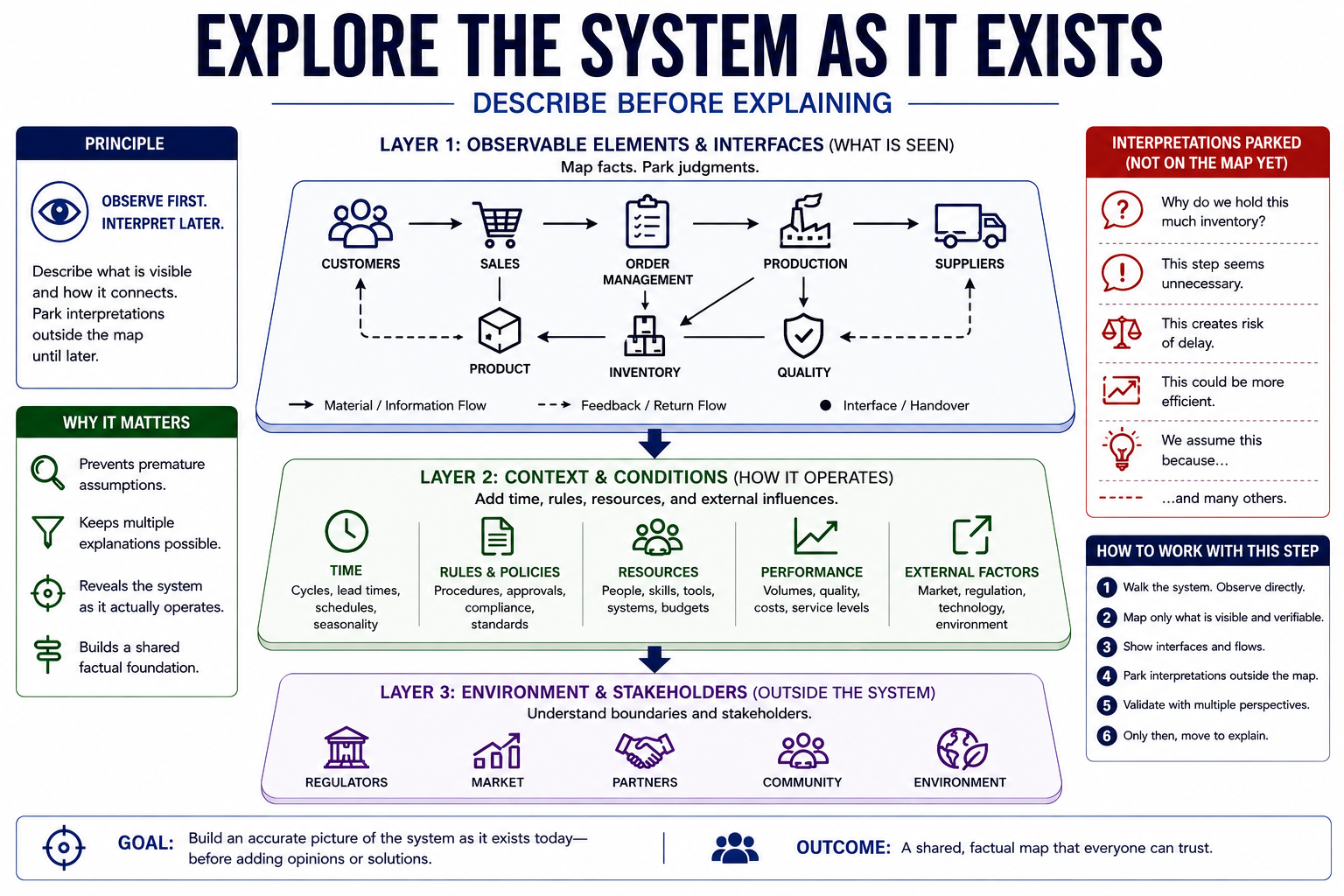
If you start explaining the system before you have described it, you are no longer observing. This step exists to force a pause that most teams instinctively resist. Once improvement intent has been defined, the temptation is to explain what is happening and why. Experts recognize patterns quickly. Experience fills gaps. Stories form. Causes are proposed. Solutions begin to surface. DECODE interrupts this reflex. Before explanation is allowed, the system must be described as it actually exists.
Describe Before You Explain#
Description and explanation are not the same thing. Description answers what is present. Explanation answers why it is that way. Most teams collapse these questions into one conversation. Observation is blended with interpretation. Assumptions are embedded in language. By the time the system is written down, it already reflects a theory. This step exists to separate seeing from explaining. When the system is described without explanation, disagreements surface early. People notice different things. Boundaries become visible. Gaps in shared understanding appear. These differences are not problems to resolve yet. They are signals that the system is not fully understood.
Observation Versus Interpretation#
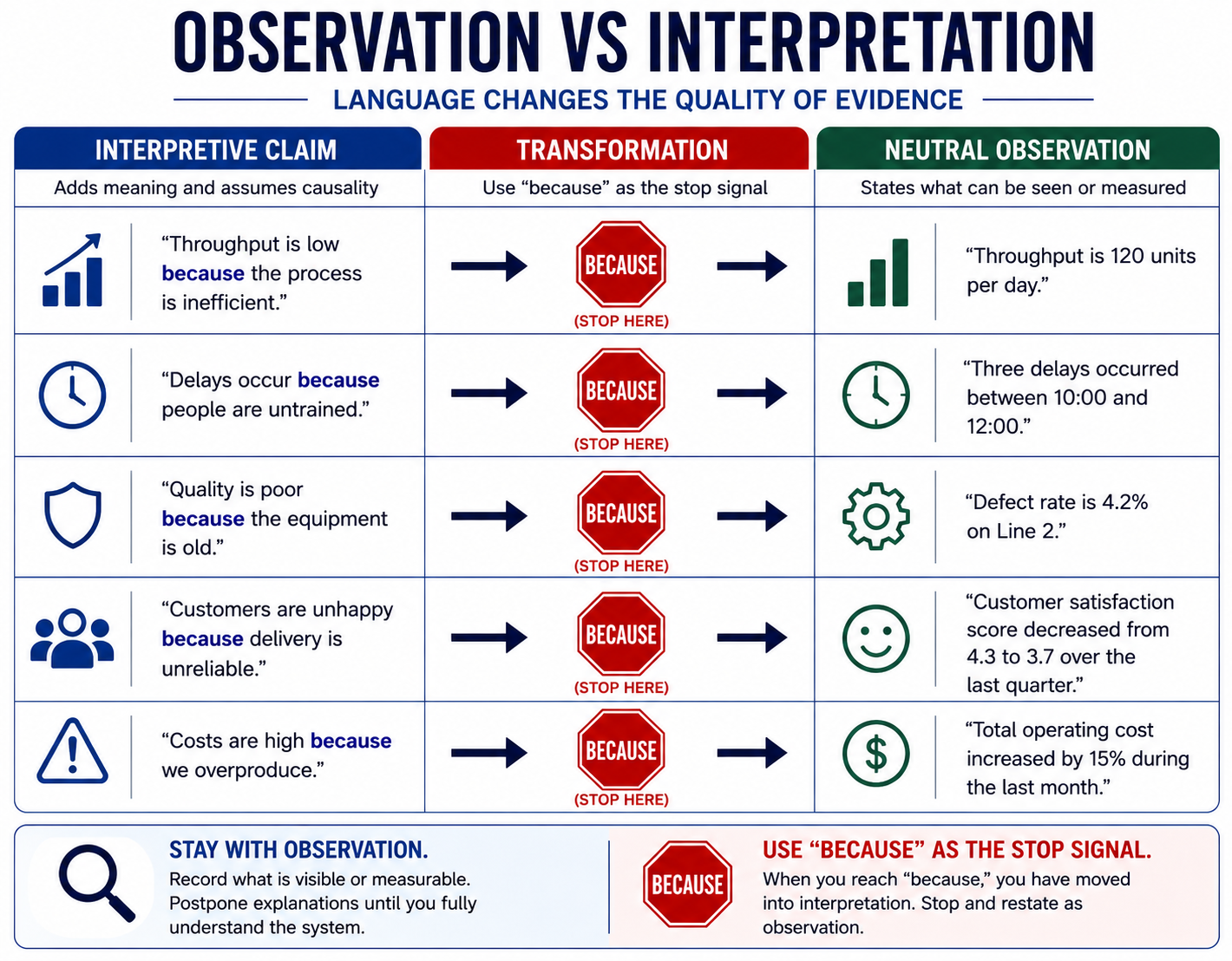
Observation refers to what can be directly seen, measured, or verified. Interpretation refers to meaning, causality, or intent attributed to those observations. The distinction sounds simple. In practice, it is difficult to maintain. Statements such as the process is unstable, the operator causes variation, or the machine is unreliable already contain interpretation. They compress observation and explanation into a single claim. DECODE requires these to be separated. A useful test is whether two people could reasonably disagree about the statement while observing the same system. If they could, interpretation has already entered. This does not make interpretation wrong. It makes it premature.
Language Discipline#
Exploration begins with description, not explanation. The difference is subtle but essential. Description captures what is present. Explanation assigns cause or meaning. The following sentences belong in this step:
- The system consists of three interacting components.
- Material flows from one stage to the next without buffering.
- Decision authority is split across two functions. The following sentences do not belong in this step:
- This happens because demand is unstable.
- The system was designed this way to save cost.
- Performance suffers due to poor coordination. When explanation enters too early, observation narrows. What looks like understanding is often assumption.
Elements, Interfaces, and Context#
Exploring the system as it exists requires attention to three things. Elements are the parts that make up the system. Machines, people, materials, information, rules, and constraints all belong here. Interfaces are where elements interact. Handovers, transitions, feedback loops, dependencies, and decision points often matter more than individual elements. Context includes conditions that shape behavior without being part of the system itself. Demand patterns, environmental conditions, organizational incentives, historical decisions, and external constraints all influence how the system behaves. Focusing only on elements produces a static picture. Focusing only on causes produces a speculative one. Seeing elements, interfaces, and context together builds a shared reference point for later reasoning.
How Experts Sabotage This Step#
Experts struggle most with this step. Experience accelerates recognition. Familiar patterns trigger explanations almost automatically. What feels like insight often bypasses observation entirely. This creates a paradox. The people best equipped to understand the system are also the most likely to skip seeing it. Expert language often hides this jump. Words like obviously, clearly, or everyone knows signal that explanation has replaced description. The system becomes a reflection of prior experience rather than current reality.
DECODE does not reject expertise. It slows it down.
By forcing experts to describe what they see without explaining it, DECODE makes assumptions visible and testable.
A Note on Expertise#
Expertise is invaluable later in DECODE. At this stage, it is a risk. Experienced practitioners are often rewarded for explaining patterns quickly. They recognize familiar shapes and supply causes from memory. This feels efficient. It is usually premature. During exploration, expertise should be used to notice detail, not to explain it. The most useful expert contributions at this step are careful descriptions of what exists, not confident explanations of why it exists. When experts begin to explain, the group should return to description without debate.
The Discipline of Restraint#
This step requires restraint. It asks teams to tolerate ambiguity longer than they would like. It delays the relief that explanation provides. It replaces confident narratives with incomplete descriptions. This discomfort is intentional. Explanation too early feels productive, but it narrows thinking. Description keeps options open. It allows multiple explanations to remain possible. Until the system is described clearly, explanation is not learning. It is storytelling.
A Simple Stop Rule#
During exploration, the word because is a signal to pause. Its appearance does not make the explanation wrong. It means explanation has begun out of sequence. When this happens, return to description: what is observed, where it occurs, and under what conditions. This rule is not meant to suppress thinking. It is meant to protect it until the right moment.
Key Takeaway#
This step is about seeing, not understanding. By separating observation from explanation, DECODE prevents assumptions from hardening into decisions. It builds a shared view of the system before causes, solutions, or judgments appear. If this step feels slow or frustrating, it is doing its job. The next chapter moves from observation to interpretation. Once the system has been described, the embedded decisions that shaped it can be examined. That is where understanding deepens.