Part III · The DECODE Logic / The Core
08Define the Improvement Intent
D Define the Improvement Intent#
If you cannot explain why change is being considered, you have no business discussing how to change anything. The first step of DECODE does not define a problem, propose a solution, or set a target. It defines intent. This distinction is critical. Most decision failures begin when intent is skipped and teams jump directly to problems, causes, or actions. By the time intent is clarified, commitment has already formed around a direction that was never explicitly chosen. DECODE starts by forcing the simplest and most uncomfortable question to be answered clearly. Why are we even considering change? Intent is easiest to misunderstand because it looks deceptively similar to a problem statement. The difference becomes clearer through contrast. An intent such as “reduce scrap by ten percent” already assumes both a problem and a direction. It collapses understanding into action. An intent such as “restore confidence in process stability under current demand” leaves the path open. It names what is at stake without implying how it should be achieved. An intent such as “replace the current system” presumes a solution. An intent such as “understand whether the current system can meet future requirements without disproportionate risk” preserves optionality.
Good intent does not narrow choice. It justifies why choice is being considered.
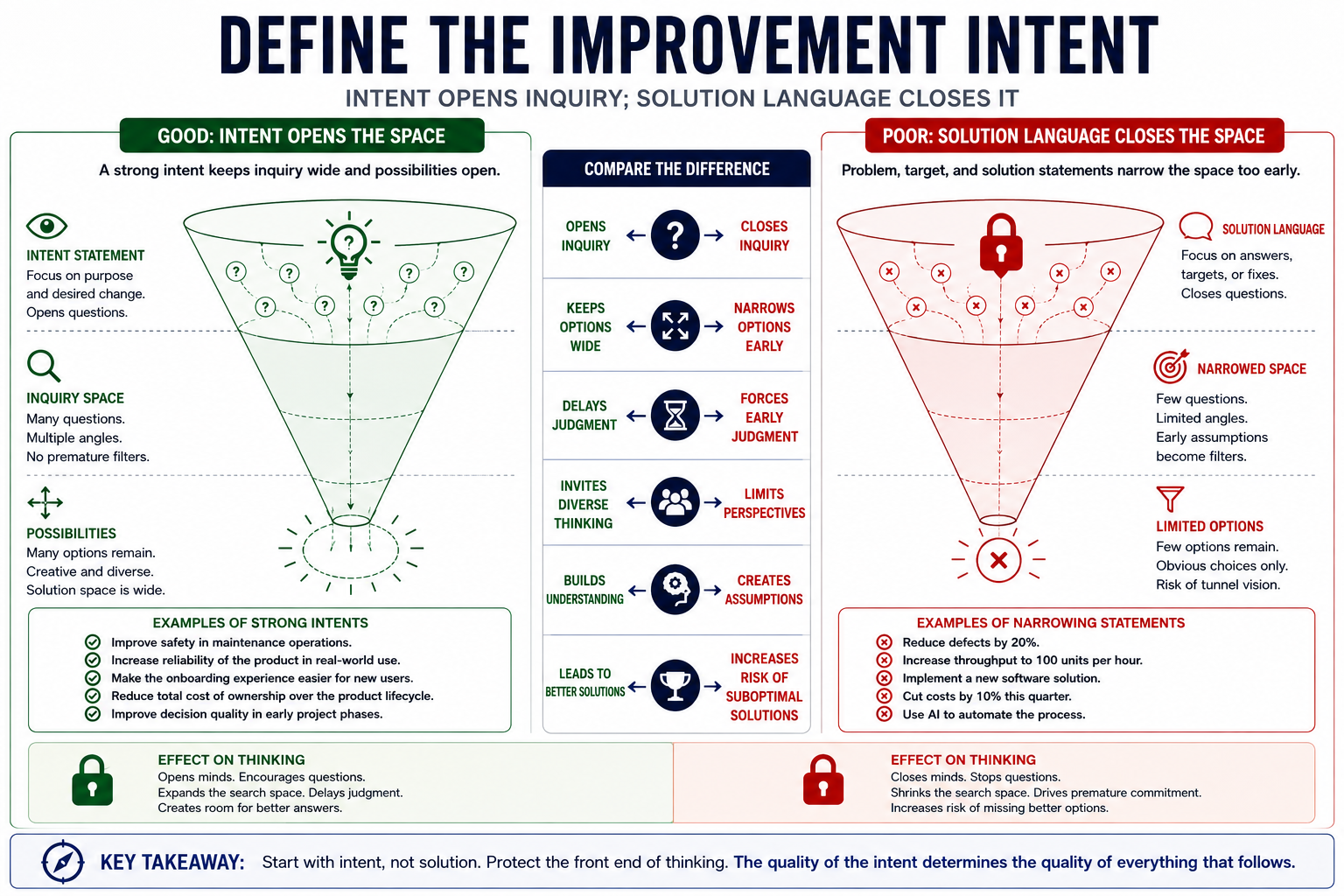
Intent Versus Problem#
Intent is often confused with a problem statement. A problem describes something undesirable in the current state. Intent describes why addressing that situation matters. The two are related, but they are not interchangeable. Problems are descriptive. Intent is directional. When intent is replaced by a problem statement, teams begin solving before deciding whether solving is worthwhile. Attention narrows. Alternatives disappear. The discussion shifts from relevance to optimization. DECODE deliberately separates these concepts to prevent premature focus. A well-defined intent allows multiple problems to be examined without assuming that any particular one must be solved.
Value Focus#
Improvement intent must be expressed in terms of value. Value may relate to safety, reliability, cost, capability, learning, resilience, or strategic positioning. What matters is not the category, but the clarity. Intent should answer what matters more if change is successful. This forces trade-offs to surface early. It prevents vague justifications such as improvement for its own sake or alignment with trends. It also prevents hidden agendas from shaping decisions later. When value is explicit, decisions become easier to evaluate. When value is implicit, decisions become easier to rationalize. At this stage, grounding does not mean proof. Acceptable grounding for intent includes observed patterns, credible concern, risk exposure, or loss of confidence that cannot be dismissed. It does not require root cause analysis, data completeness, or consensus. The purpose of intent is not to be correct. It is to be honest about why the existing state is being questioned.
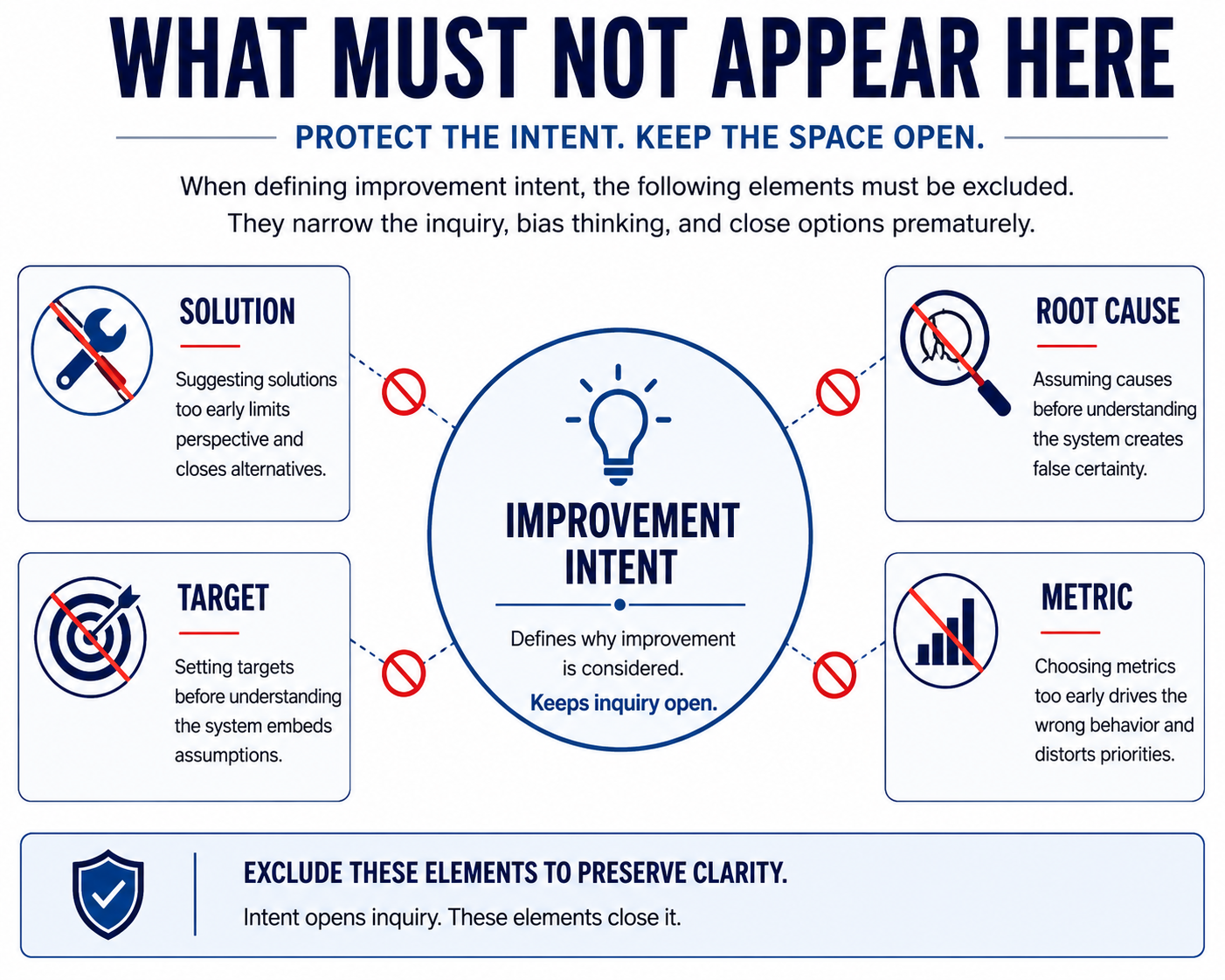
What Must Not Appear Here#
Certain things do not belong in an intent statement.
- Solutions do not belong here.
- Root causes do not belong here.
- Targets do not belong here.
- Metrics do not belong here. Including these elements collapses the decision too early. It turns intent into a disguised solution and makes later steps performative. The purpose of intent is not to narrow options. It is to justify exploration. If an intent statement already implies what must be done, the decision has already been made.
- The intent is framed so broadly that it cannot guide decisions.
- The intent is framed so narrowly that only one outcome fits.
- The intent is written to justify a preferred solution.
- The intent is copied from a strategy document without relevance to the situation. When these failure modes appear, the rest of DECODE becomes constrained. The method still runs, but it no longer protects decision quality. Catching these failures early prevents wasted effort later.
What a Good Intent Feels Like#
A good intent often feels uncomfortable. It feels incomplete. It invites questions rather than answers. It resists immediate action. This discomfort is a signal that the step is working. Intent is meant to slow the rush toward solutions and force alignment on purpose before action. A good intent creates space rather than direction. It enables exploration without commitment. If the intent feels energizing and decisive, it is often too close to a solution.
Key Takeaway#
Improvement intent defines why change is worth considering, not what should be done. It anchors the decision in value before problems, solutions, or targets appear. When intent is weak or implied, commitment forms accidentally. Getting this step right does not guarantee a good decision. Skipping it almost guarantees a fragile one. The next chapter moves from intent to observation. Before explanations can be trusted, the system must be seen as it actually exists. That is where DECODE continues.