Part III · The DECODE Logic / The Core
12Decide the Improvement Path
D Decide the Improvement Path#
A decision is a commitment, not an intention and not a plan. By this point in DECODE, understanding has been built deliberately. Intent has been defined. The system has been described. Embedded decisions have been clarified. Boundaries have been outlined. Only now is a decision allowed. This step exists to convert understanding into commitment. Not activity. Not exploration. Commitment.
Only Three Legitimate Outcomes#
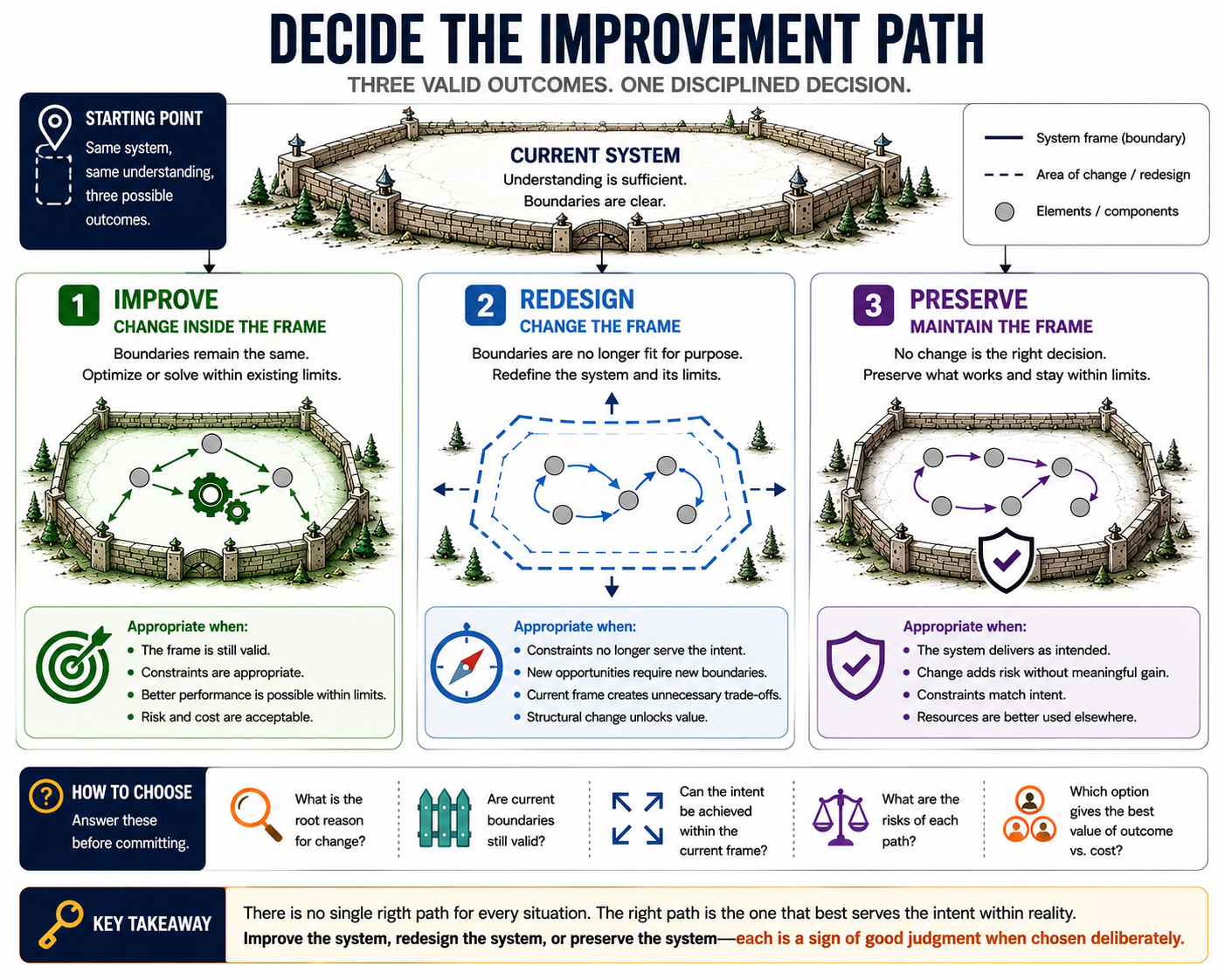
DECODE allows only three decision outcomes. Improve. Redesign. Preserve. These outcomes are frequently confused. Their distinctions matter. Outcome What It Means What It Does Not Mean Improve Adjust within current boundaries Gradual redesign disguised as improvement Redesign Change structure beyond current boundaries Cosmetic upgrade Preserve Explicitly maintain current state Avoiding responsibility Table 12-1. The Only Valid Decision Outcomes. Improve, Redesign, and Preserve define the level and boundary of commitment. Improve, Redesign, and Preserve are decision paths, not detailed solutions. They define the level and boundary of commitment. Detailed solution design occurs only after closure. These outcomes are mutually exclusive. Choosing one excludes the others. Improve commits the organization to making targeted changes within the existing system. Redesign commits the organization to creating a fundamentally different system. Preserve commits the organization to maintaining the current system and accepting its limitations. Anything that does not clearly fit one of these three categories is not yet a closed DECODE decision. Anything else is a variation of one of these or an attempt to avoid deciding. This restriction is intentional. It prevents ambiguity from leaking into commitment and forces clarity about what will actually happen next.
Avoiding a clear choice among these outcomes does not preserve flexibility. It creates ambiguity while allowing commitment to form informally.
Improve#
Improve means change within existing boundaries. The system remains fundamentally the same. Its structure, interfaces, and constraints are accepted. The decision is to optimize performance, stability, or capability without redefining the system itself. Improvement is appropriate when the intent is valid, the system is understood, and boundaries allow meaningful gains. Choosing improve is a commitment to work within what already exists.
Redesign#
Redesign means change beyond existing boundaries. The system itself is altered. Interfaces change. Roles shift. Constraints are redefined. The decision acknowledges that improvement within the current structure is insufficient to meet the intent. Redesign is appropriate when understanding shows that the system as designed cannot deliver the required value. Choosing redesign is a commitment to disruption, risk, and redefinition. It is not an escalation of improvement. It is a different decision altogether.
Preserve#
Preserve means consciously choosing not to change. This outcome is often misunderstood. Preserve is not inaction by default. It is a decision based on understanding that change is not justified, not safe, or not worth the cost at this time. Preserve may be temporary or durable. What matters is that it is explicit. Choosing preserve protects value by avoiding unnecessary disturbance.
Why There Are No Other Options#
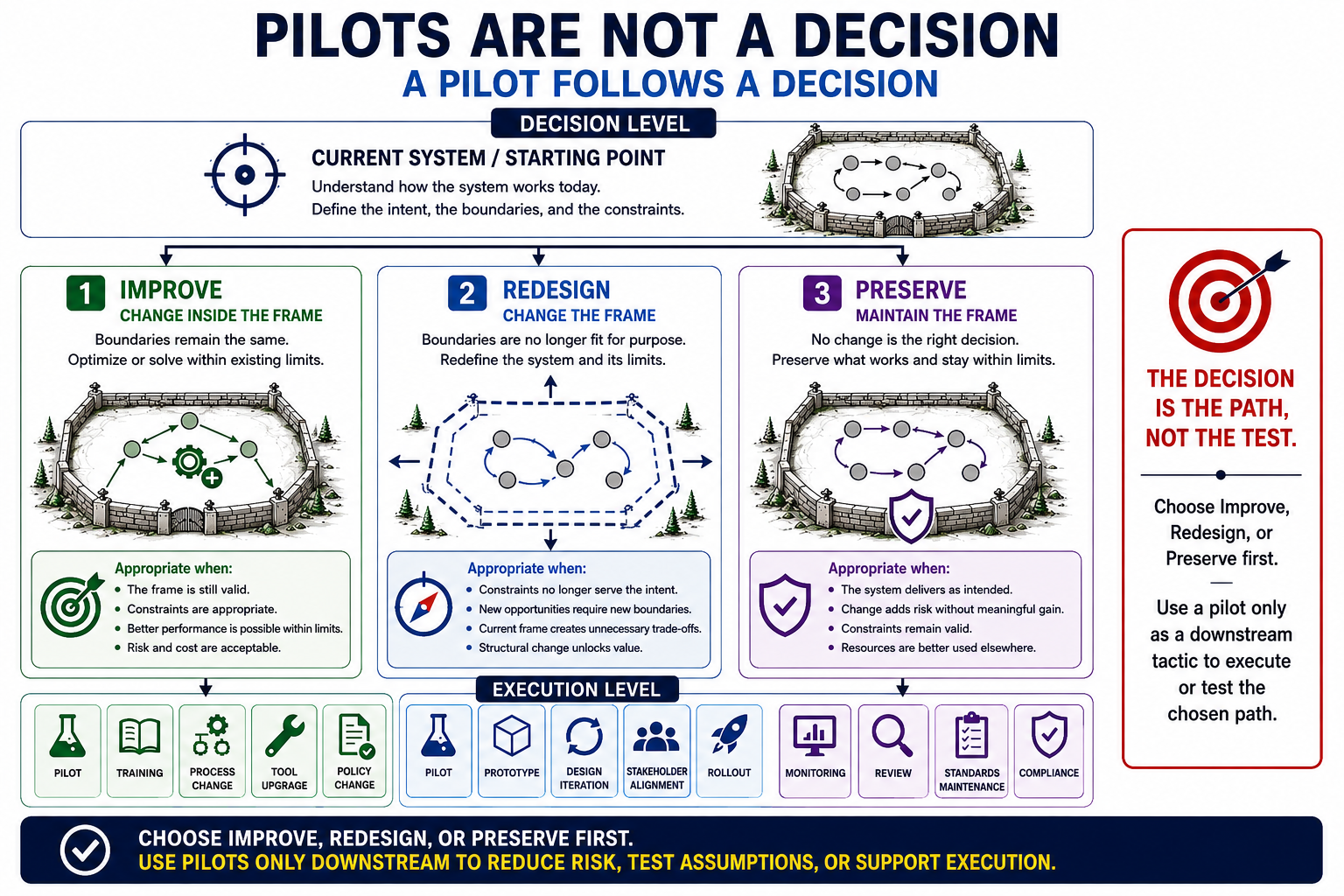
Attempts to invent additional outcomes usually signal discomfort with commitment. Phrases such as explore further, pilot quietly, or start small often mask an unwillingness to decide. They defer commitment while allowing momentum to build. DECODE rejects this ambiguity. Exploration belongs earlier. A pilot may follow an Improve or Redesign decision, but it is not itself a decision outcome. Starting small is a planning choice, not a decision outcome. Forcing one of the three outcomes makes commitment visible.
The Discipline of Stating the Decision#
A decision must be stated clearly. It should fit in two sentences. One sentence to name the outcome. One sentence to state why it is justified based on understanding. If the decision cannot be stated this simply, it is not ready. Clarity is evidence that reasoning has converged.
What This Step Protects#
This step protects the organization from drifting into action without ownership. When decisions are vague, execution absorbs uncertainty. Teams interpret intent differently. Accountability blurs. Revisit conditions disappear. A clear decision creates a reference point. It defines what was chosen, what was not chosen, and why.
Pilots Are Not a Decision#
Pilots are often proposed as a safe compromise. They feel reversible and responsible. In DECODE, a pilot is not a decision outcome. It is a tactic that may follow an Improve or Redesign decision. Proposing a pilot before choosing an outcome hides commitment rather than avoiding it. Resources are allocated, attention shifts, and alternatives begin to disappear. If a pilot cannot be clearly tied to one of the three outcomes, the decision has not been made.
Key Takeaway#
Deciding the improvement path is the moment where understanding becomes commitment. DECODE allows only three outcomes because clarity demands constraint. If a decision cannot be stated simply, it is not yet a decision. The final step completes the DECODE sequence. Once a decision is made, it must be preserved as reasoning, not rewritten by outcomes. That is where DECODE ends.