Part III · The DECODE Logic / The Core
13Establish Closure
E Establish Closure#
A decision that is not closed will be rewritten by memory. This final step of DECODE exists to protect decisions after they are made. Without closure, even well -reasoned decisions degrade. Assumptions fade. Trade -offs are forgotten. Intent is reinterpreted through outcomes. Over time, the decision becomes whatever the current situation requires it to have been. Closure prevents this erosion. It preserves the reasoning behind commitment so that decisions remain explainable, defensible, and revisitable.
The Minimum Closure Set#
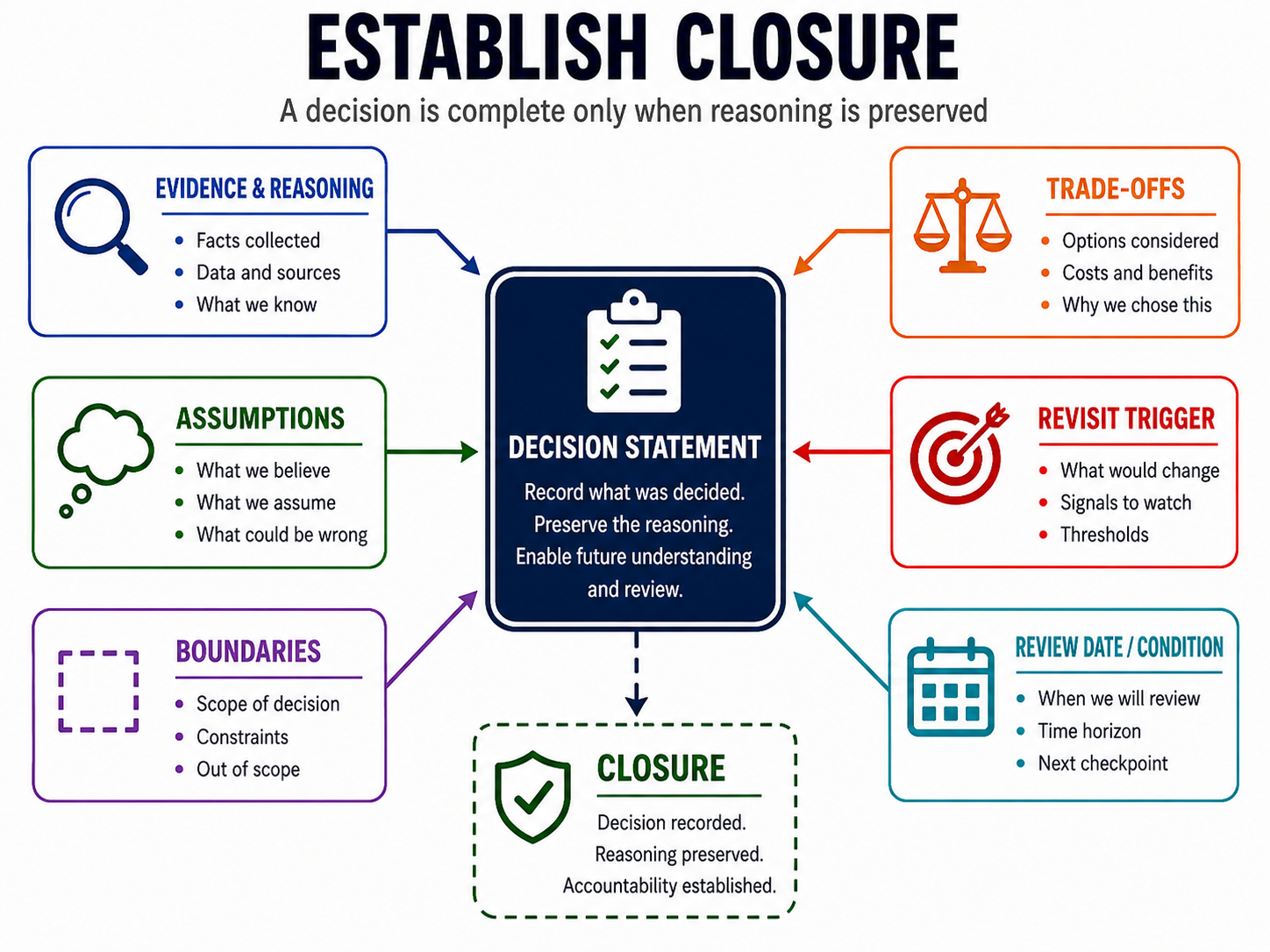
Closure does not require exhaustive documentation. It requires preservation of reasoning. At minimum, closure must capture the following:
- The decision that was made
- The evidence and known facts supporting it
- The assumptions that must remain true
- The boundaries and scope of the decision
- The trade-offs accepted deliberately
- The conditions that trigger reconsideration
- The review date or review condition Without these elements, decisions become difficult to explain and impossible to revisit without conflict.
Why Reasoning Disappears#
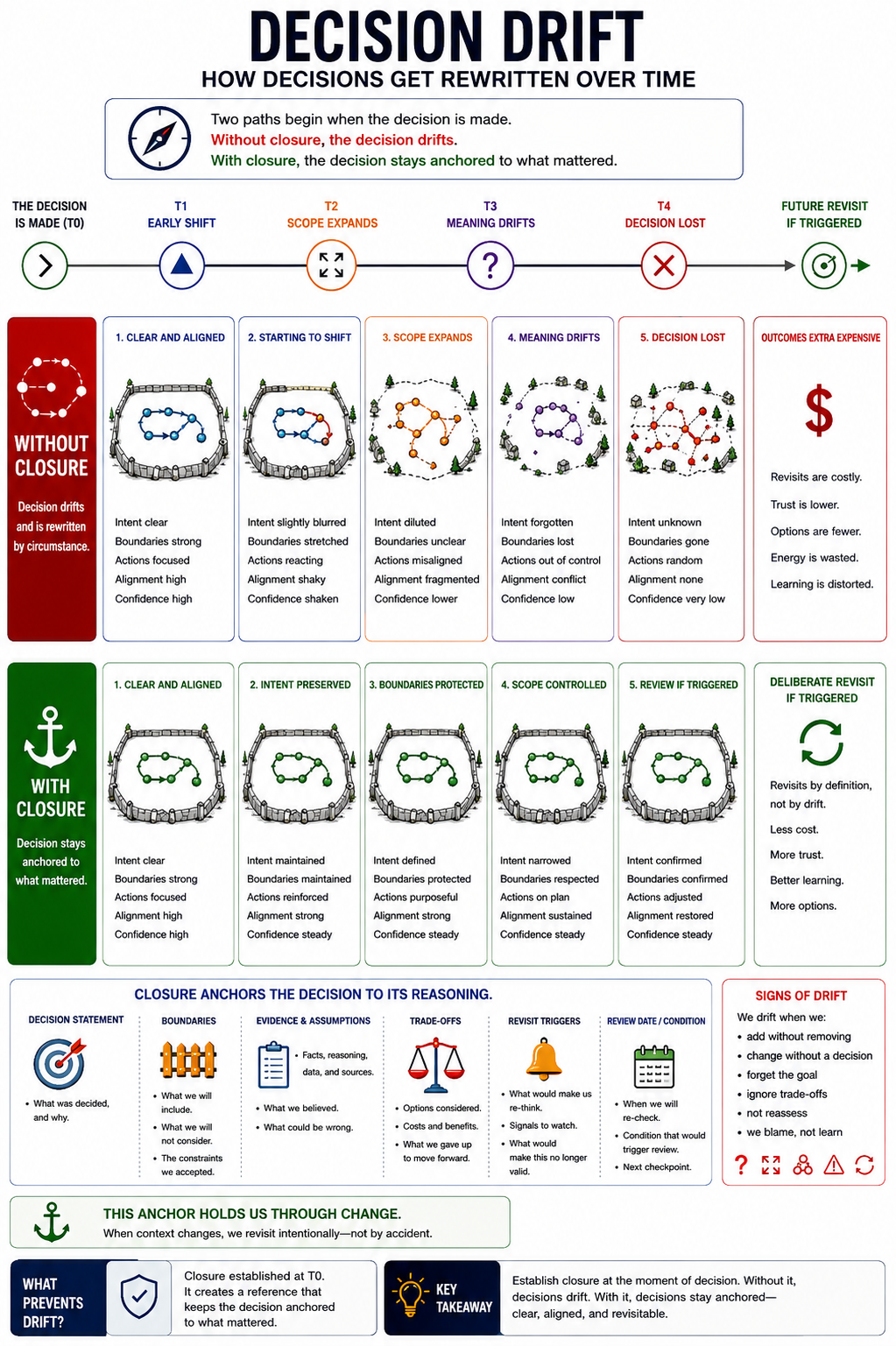
Reasoning is fragile. Once execution begins, attention shifts to delivery. New information appears. Conditions change. Pressures evolve. People move on. The logic that justified the decision is gradually overshadowed by what is happening now. This is not negligence. It is normal organizational behavior. Without explicit preservation, reasoning is replaced by results. If outcomes are good, the decision is remembered as obvious. If outcomes are poor, it is judged as flawed without reference to the conditions under which it was made. Over time, the past is quietly rewritten to match the outcome. What was once an assumption may be remembered as a fact. What was once a trade-off may disappear entirely. Eventually, teams can find themselves arguing about what was intended rather than what should now be done. In both cases, learning is distorted. Closure anchors a decision in the context in which it was made. It preserves the reasoning, assumptions, and trade-offs so they can later be examined against what actually happened. Closure protects decisions not from change, but from amnesia.
Protecting Decisions From Memory#
Memory simplifies. It compresses complexity. It removes uncertainty. It reconstructs intent to fit what is known now. Over time, this process creates a cleaner story but a weaker understanding. Closure counters this tendency by recording reasoning explicitly.
- What was understood at the time.
- What was uncertain.
- What risks were accepted.
- What alternatives were considered and rejected. This record does not need to be extensive. It needs to be honest. Without it, organizations lose the ability to distinguish between decisions that failed and decisions that were overtaken by change.
Assumptions and Trade-Offs#
Every decision rests on assumptions. Some assumptions are explicit. Others are implicit. All of them influence outcomes. Closure requires that key assumptions be named. Not to defend them, but to make them visible. When assumptions are later violated, the decision can be revisited without blame. Trade-offs must also be captured. Every commitment favors certain values at the expense of others. Cost over flexibility. Speed over robustness. Simplicity over performance. These trade -offs are often obvious at the moment of decision and invisible later. Closure preserves them. This prevents future discussions from proceeding as if all goals were equally prioritized.
Revisit Triggers#
Closure does not mean finality. Decisions should be revisited when conditions change materially. Closure defines what change would justify that revisit. Revisit triggers may include shifts in demand, performance thresholds, regulatory changes, technological availability, or strategic direction. What matters is not the number of triggers, but their clarity. Without revisit triggers, decisions either become permanent by default or are reopened arbitrarily. Closure replaces both extremes with discipline.
Preventing Decision Drift#
Decision drift occurs when action continues but commitment quietly changes. Scope expands. Intent shifts. Constraints soften. Over time, the organization is doing something different from what was originally decided without ever acknowledging the change. This drift is rarely intentional. It emerges when decisions are not closed. Closure creates a stable reference point. It allows teams to ask whether current actions still align with the original decision or whether a new decision is required. When drift is detected early, it can be corrected cleanly. When it is detected late, it is defended.
Closure as an Organizational Asset#
Closed decisions accumulate value. They create a library of reasoning. They enable faster future decisions. They improve trust because choices can be explained without reconstruction. Most importantly, they allow organizations to learn honestly. Closure turns individual decisions into shared assets rather than isolated events.
Key Takeaway#
Closure protects decisions from being rewritten by memory and circumstance. By capturing reasoning, assumptions, trade-offs, and revisit triggers, DECODE ensures that commitment remains legible over time. This is where the method ends. What follows is execution, learning, and change. If those processes raise new questions of commitment, DECODE can be used again. But each use begins and ends with clarity. That is the discipline.