Part IV · Using DECODE in Real Life
14DECODE in Practice
How It Actually Feels#
Using DECODE feels slower than acting and faster than recovering from a bad decision.
Applying DECODE rarely feels smooth. Conversations slow down. Confidence drops before it rises. Familiar patterns of discussion stop working. People who are used to moving quickly may feel exposed or frustrated. This discomfort is not a sign of failure. It is a sign that implicit assumptions are being surfaced and that commitment is being withheld deliberately. In practice, DECODE feels less like progress and more like friction. That friction is the cost of clarity. This chapter is not about theory or structure. It is about experience. On paper, DECODE looks orderly. In practice, it feels uncomfortable, uneven, and occasionally frustrating. That discomfort is not a sign that the method is failing. It is a sign that familiar shortcuts are being blocked. Understanding how DECODE feels in use is essential to using it well.
Facilitation and Pacing#
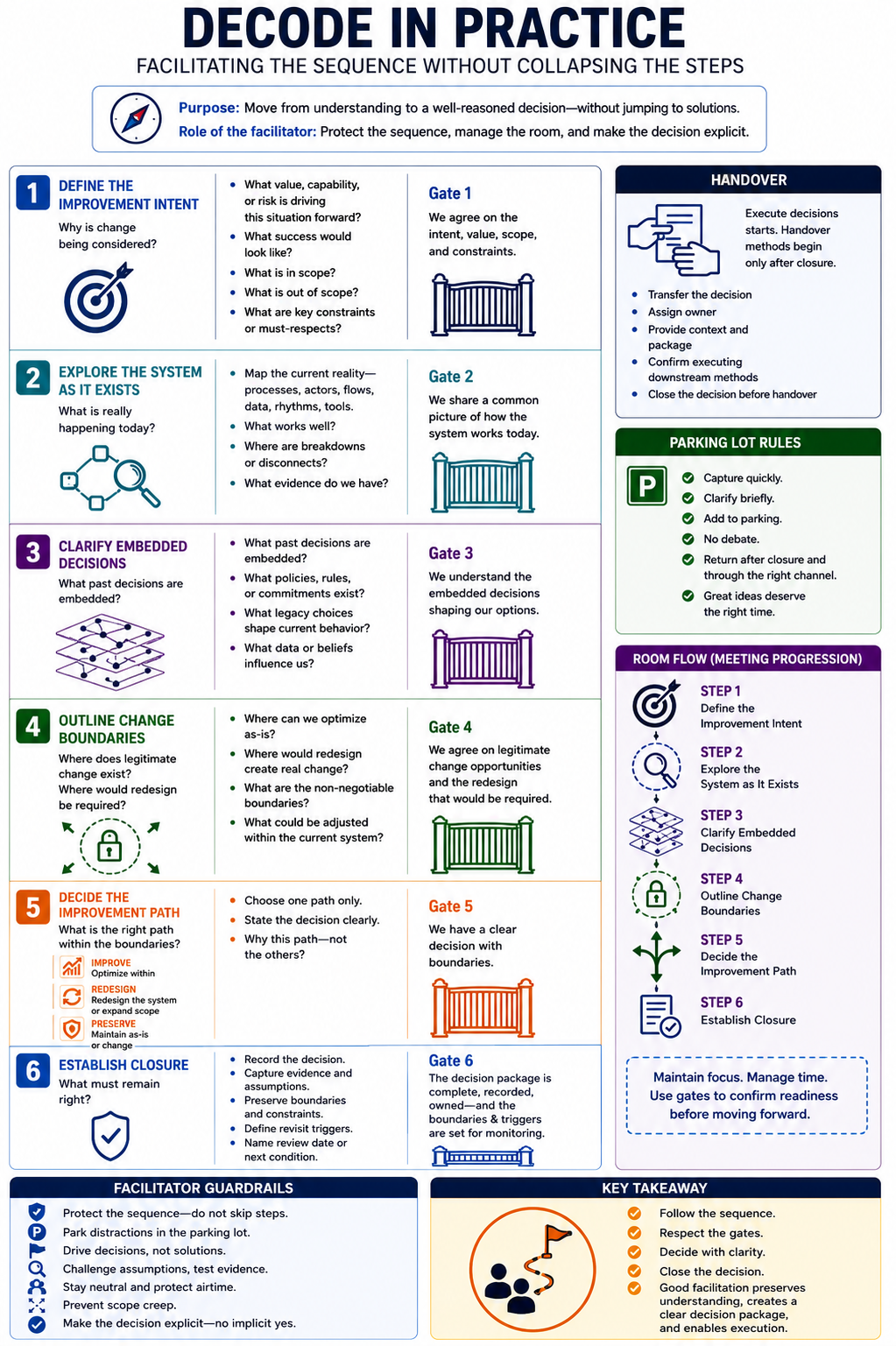
DECODE does not run itself. It requires facilitation, whether formal or informal. Someone must protect the sequence, slow the conversation when it rushes ahead, and redirect it when it collapses into solutions. Pacing matters more than speed. Some steps move quickly. Others stall. Teams often want to accelerate precisely where restraint is most valuable. Facilitation is less about keeping momentum and more about maintaining order. Good facilitation feels restrictive at first. Over time, it becomes protective.
Where Teams Struggle Most#
Most teams struggle at the same five points, especially where discipline replaces intuition.
- Defining intent without implying a solution can feel abstract or artificial because teams naturally want to move quickly toward answers.
- Exploring the system before explaining it can feel slow, particularly to experts who already have a diagnosis in mind.
- Clarifying embedded decisions can feel political because it surfaces past choices, assumptions, and commitments that may no longer be questioned openly.
- Outlining boundaries can feel limiting because it may rule out ideas or directions in which people have already invested time, credibility, or effort.
- Making the decision explicit can feel uncomfortable because it requires clear commitment rather than allowing alignment to emerge gradually or remain ambiguous. These struggles are predictable, and they are informative. Strong resistance often signals that a step is exposing an assumption, challenging an existing commitment, or narrowing a preferred direction. In that sense, resistance is not evidence that the method is failing. It often reveals exactly where decision quality is most at risk.
Discomfort Is Part of the Method#
DECODE is designed to create discomfort. It interrupts habits that teams rely on to feel productive. It delays action when action feels urgent. It forces uncertainty to remain visible longer than is comfortable. This discomfort often shows up as impatience, skepticism, or attempts to shortcut steps. People may ask whether the process is necessary, whether the discussion is going in circles, or whether it would be better to just start. These reactions are normal. They indicate that the method is doing its job.
When to Pause#
Pausing is not failure. DECODE should pause when understanding is insufficient to proceed responsibly. This may happen after any step. New information may be required. Observations may need to be revisited. Assumptions may need to be tested. Pausing preserves integrity. Continuing without understanding creates momentum without justification. That momentum will later demand defense. A deliberate pause is cheaper than a forced reversal.
When to Loop Back#
Looping back is sometimes necessary. New insights may reveal that intent was poorly framed. Boundaries may expose assumptions embedded earlier. Clarifying decisions may change how the system is understood. Looping back is not restarting. It is refining understanding in light of new clarity. The sequence still matters. What changes is the quality of the inputs. Looping back deliberately prevents drift. Looping back unconsciously creates confusion.
When to Stop#
DECODE must stop once a decision has been made and closure has been established. Continuing to apply it during execution blurs responsibility and invites reinterpretation. Once commitment is established and closed, the method has completed its role. Stopping is as important as starting. If DECODE continues indefinitely, it becomes avoidance. If it stops too early, it becomes ritual. Knowing when to stop reflects decision maturity.
What Good Practice Looks Like#
In practice, DECODE often looks uneven. Some steps are brief. Others are intense. Some decisions resolve quickly. Others require multiple passes. What matters is not smoothness, but integrity. When used well, DECODE reduces noise, shortens debate, and prevents initiatives that should never have started. It replaces false urgency with justified commitment. This may not feel efficient in the moment. It is efficient over time.
When to Pause, Loop Back, or Stop#
Pausing is appropriate when the group cannot articulate intent clearly or when explanations begin to dominate exploration. Looping back is appropriate when new information undermines earlier assumptions or reveals embedded decisions that were missed. Pause when the decision is not yet justifiable and further understanding is required. Stop when Improve, Redesign, or Preserve has been chosen explicitly and the reasoning has been closed. None of these actions represent failure. They represent control over commitment.
Key Takeaway#
DECODE works by changing how decisions feel before it changes what decisions are made. Discomfort, pauses, and resistance are signals, not problems. They indicate where understanding is being protected. Used with discipline, DECODE does not slow organizations down. It stops them from moving in the wrong direction. The next chapter shows how DECODE behaves at different scales and why small decisions often create the greatest damage when decision discipline is ignored.