Part IV · Using DECODE in Real Life
17DECODE and Existing Methods
Most methods fail not because they are weak, but because they are used too early. Lean, Six Sigma, A3, and similar approaches are powerful. They have transformed industries and delivered real value. DECODE does not replace them, compete with them, or correct them. It protects them. This chapter explains where existing methods shine, where they quietly assume too much, and how DECODE prevents them from being applied in the wrong situations.
What These Methods Assume#
Methods such as Lean, Six Sigma, and A3 are highly effective when used in the situations they were designed for. They excel at improving performance once direction is justified. What they all assume, implicitly or explicitly, is that the organization already knows what problem it is solving and that acting is appropriate. When that assumption holds, these methods create clarity, discipline, and learning. When it does not, they accelerate commitment to an unstable direction.
Where These Methods Shine#
Established improvement methods excel when the direction of action is already justified. Lean reduces waste when the value stream is understood. Six Sigma reduces variation when the process is stable enough to measure meaningfully. A3 supports structured problem-solving when the problem is real, bounded, and worth solving. In these contexts, execution discipline creates value. These methods assume that improvement is necessary and that acting is appropriate. They focus on how to change the system, not whether it should be changed. When those assumptions hold, they work exceptionally well.
Where They Assume Too Much#
Problems arise when these methods are applied before those assumptions are true. Lean, Six Sigma, and A3 all assume that the problem being addressed is relevant, that the system boundaries are understood, and that the direction of improvement is valid. When these assumptions are wrong or incomplete, the methods still produce output. Data is collected. Causes are identified. Actions are proposed. Progress appears to be made. What is missing is decision quality. The method optimizes within a framing that may itself be flawed. Execution improves. Commitment deepens. The organization becomes more efficient at pursuing the wrong thing. This is not a failure of the method. It is a failure of timing.
How DECODE Protects Existing Methods#
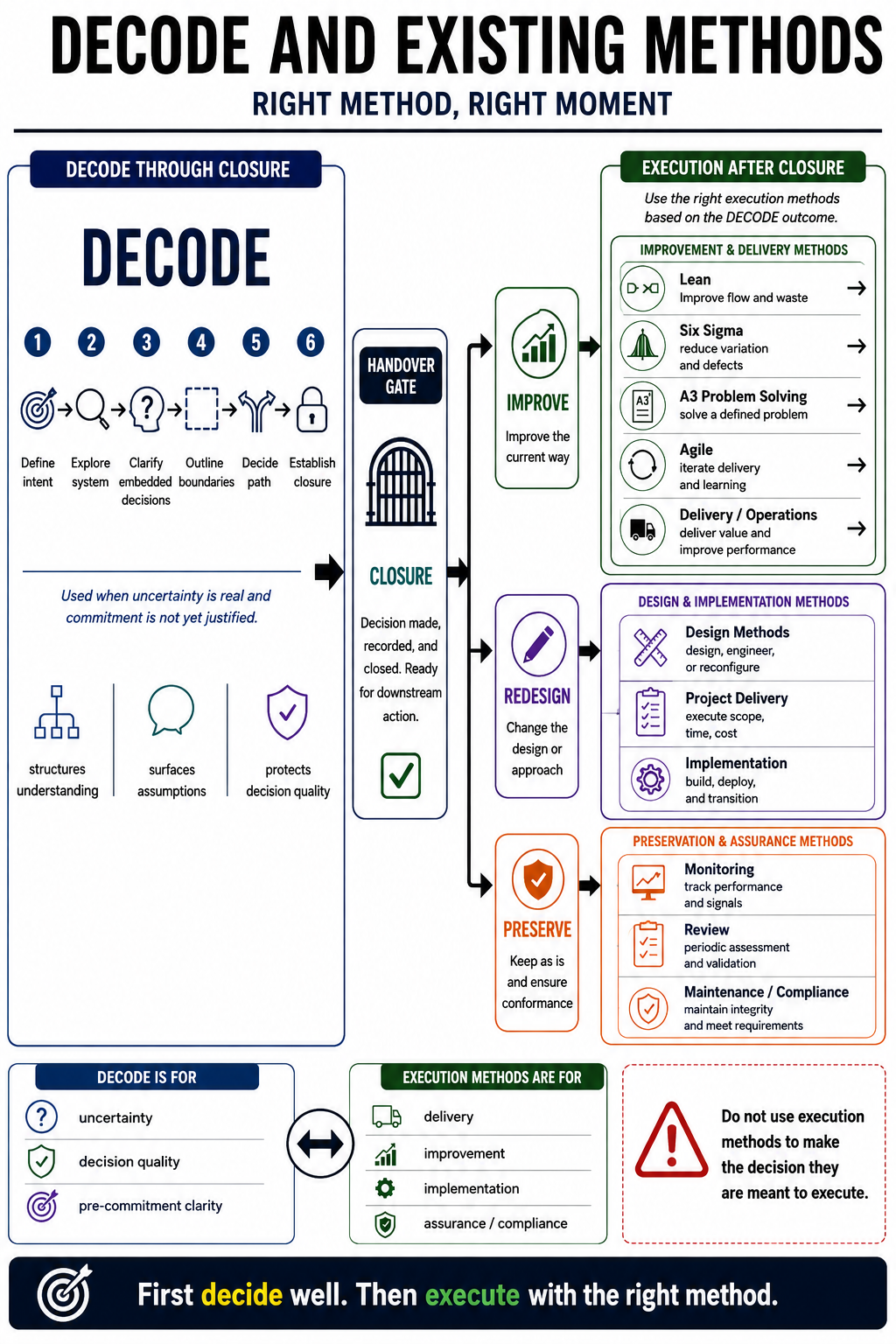
DECODE acts before these methods begin. It ensures that improvement intent is clear, that the system is understood, that embedded decisions are surfaced, and that boundaries are respected before optimization starts. By doing so, DECODE protects Lean, Six Sigma, and A3 from being misapplied. It prevents problem- solving from becoming problem creation and ensures that execution effort is spent where it is justified.
Execution After Closure#
Closure determines what happens next. It does not automatically trigger an improvement method. An Improve decision can move into the appropriate improvement or delivery method. A Redesign decision can move into the method suited to redesign, development, transformation, or implementation. A Preserve decision follows a different path. It confirms that the current structure remains justified and should continue through appropriate monitoring, maintenance, review, or compliance, rather than being routed into an improvement method. DECODE selects the level and boundary of commitment: Improve, Redesign, or Preserve. It does not select the detailed technical solution that follows. An Improve decision establishes that change should occur within the existing structure. A Redesign decision establishes that the structure itself may be changed. A Preserve decision establishes that the current structure should remain. The specific design, technology, process, configuration, or implementation solution is developed only after that decision has been closed and the appropriate downstream method has satisfied its own entry conditions. Each downstream method must still satisfy its own entry conditions before execution begins. DECODE establishes and preserves the justification for the direction taken; it does not replace the requirements of the method that follows.
DECODE as a Gate#
DECODE functions as a gate. Not a bureaucratic gate, but a logical one. It asks whether the conditions required for effective problem-solving exist. If they do and closure has been established, DECODE steps aside. If they do not, DECODE blocks premature action. This gating role is often misunderstood. DECODE does not slow improvement. It prevents wasted improvement. By stopping initiatives that should never start, it frees capacity for those that matter.
A Complement, Not a Competitor#
DECODE does not introduce new tools for execution. It introduces discipline for deciding when execution should begin. This makes it complementary by design. Organizations that already use Lean, Six Sigma, or A3 gain the most from DECODE because it sharpens their use rather than replacing them. When DECODE is absent, strong execution methods amplify decision mistakes. When DECODE is present, those same methods become more effective.
What Changes in Practice#
When DECODE is used as a gate, conversations change. Fewer initiatives are launched. Those that proceed have clearer intent. Disagreements surface earlier. Rework decreases. Learning improves. Execution becomes calmer, not slower. Teams stop arguing about solutions and start focusing on whether action is justified.
Key Takeaway#
DECODE does not compete with existing methods. It protects them by ensuring they are applied only when their assumptions hold. By acting as a gate rather than a replacement, DECODE preserves execution excellence and prevents it from being wasted on premature commitments. The next chapter explores what changes inside organizations when decision quality becomes a capability rather than an exception.