Part V · What Changes When You Get This Right
18Decision Quality as a Capability
Organizations age through the decisions they make, not through the work they execute. Organizations do not age primarily through people or technology. They age through decisions. Each decision embeds assumptions, constraints, and trade -offs into the system. Over time, these accumulate. Some remain appropriate. Others quietly outlive their relevance. When decision quality is low, organizations accumulate fragility. When decision quality is high, they accumulate clarity. DECODE does not prescribe which decisions an organization must make. It changes how decisions are formed, justified, preserved, and allowed to compound over time. That discipline can change the decision ultimately reached. By exposing assumptions, constraints, dependencies, and trade -offs before commitment, DECODE may lead an organization to improve, redesign, preserve, or reject a direction it might otherwise have accepted. The method does not determine the answer in advance. It improves the conditions under which the answer is formed. Processes mature. Technologies evolve. People rotate. What remains is the accumulated effect of past commitments. Over time, decisions shape what an organization can do easily, what it struggles to do, and what it can no longer do at all. When decision quality is inconsistent, organizations accumulate noise, fragmentation, and technical debt. When decision quality becomes a capability, the organization behaves differently in ways that are subtle but profound.
Organizations Age Through Decisions#
Every decision leaves residue. Some decisions expand capability. Others constrain it. Many appear neutral at the time but later define limits. As decisions accumulate, the organization becomes shaped less by strategy and more by history. This is what organizational aging looks like. It is not decline. It is sediment. When decisions are made implicitly or without discipline, sediment accumulates unevenly. Workarounds multiply. Exceptions harden. Systems become fragile. The organization spends more energy maintaining past choices than creating future ones. Decision quality determines whether aging produces resilience or rigidity.
Better Disagreement#
Improved decision quality changes how disagreement works. Disagreement moves earlier. It becomes more explicit. It is less personal and more structural. People argue about intent, boundaries, and assumptions rather than about solutions or execution. This kind of disagreement is productive. Because reasoning is explicit, disagreement does not threaten authority. It sharpens understanding. It reduces the need for alignment through hierarchy. Over time, trust increases. People learn that raising concerns early prevents larger problems later. What Changes When Decision Quality Improves Improvements in decision quality are rarely announced. They become visible through absence rather than presence.
- There are fewer initiatives launched on weak premises.
- Disagreements become more focused and less personal.
- Meetings spend more time clarifying intent and less time defending positions.
- Decisions are easier to explain months later, even when outcomes are mixed.
- Learning becomes cumulative rather than episodic because reasoning is preserved. These changes are subtle, but they compound. Over time, they reshape how the organization thinks and acts.
Cleaner Learning#
When decisions are closed properly, learning becomes cleaner. Outcomes can be compared against assumptions rather than against expectations reconstructed after the fact. Failures are examined in context. Successes are not overinterpreted. This clarity improves judgment. Organizations stop confusing luck with skill. They become better at recognizing when a decision was sound but conditions changed and when a decision was weak from the start. Learning accelerates because reasoning is preserved.
From Individual Skill to Organizational Capability#
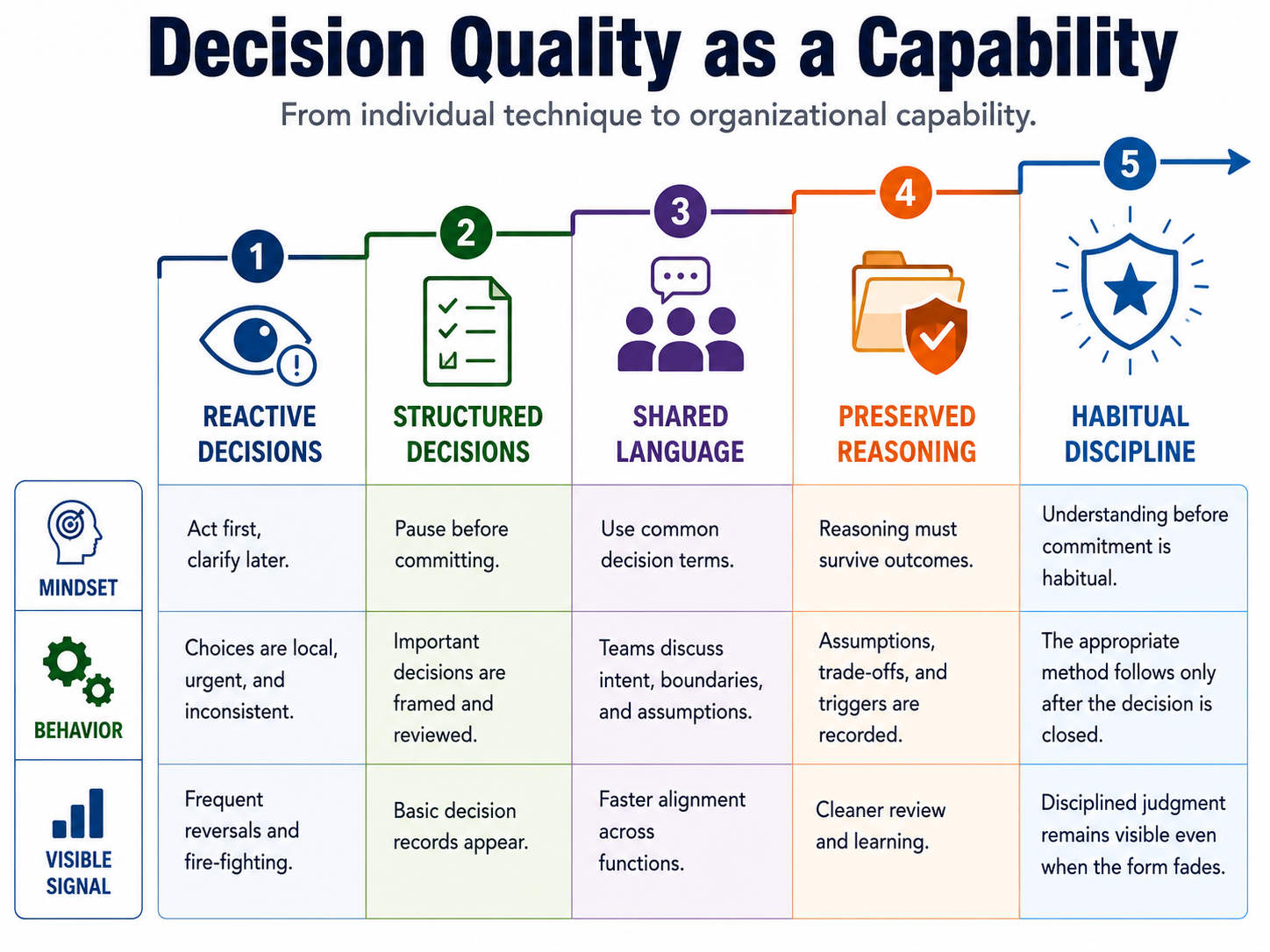
Decision quality often begins with individuals. A thoughtful leader. A disciplined engineer. A careful manager. Over time, however, these behaviors can become systemic. When DECODE or similar discipline is used consistently, the organization develops shared language, shared expectations, and shared patience around decisions. Decision quality stops depending on who is in the room. It becomes embedded in how work begins. This is what turns decision quality into a capability.
Key Takeaway#
Organizations do not become resilient by moving faster or optimizing harder. They become resilient by committing less often and more deliberately. When decision quality is treated as a capability rather than an exception, noise decreases, disagreement improves, and learning becomes reliable. The next chapter explores what maturity looks like when this discipline is fully absorbed and formal use becomes selective. That is where DECODE ultimately aims.