Part V · What Changes When You Get This Right
19When DECODE Disappears
That Is Success#
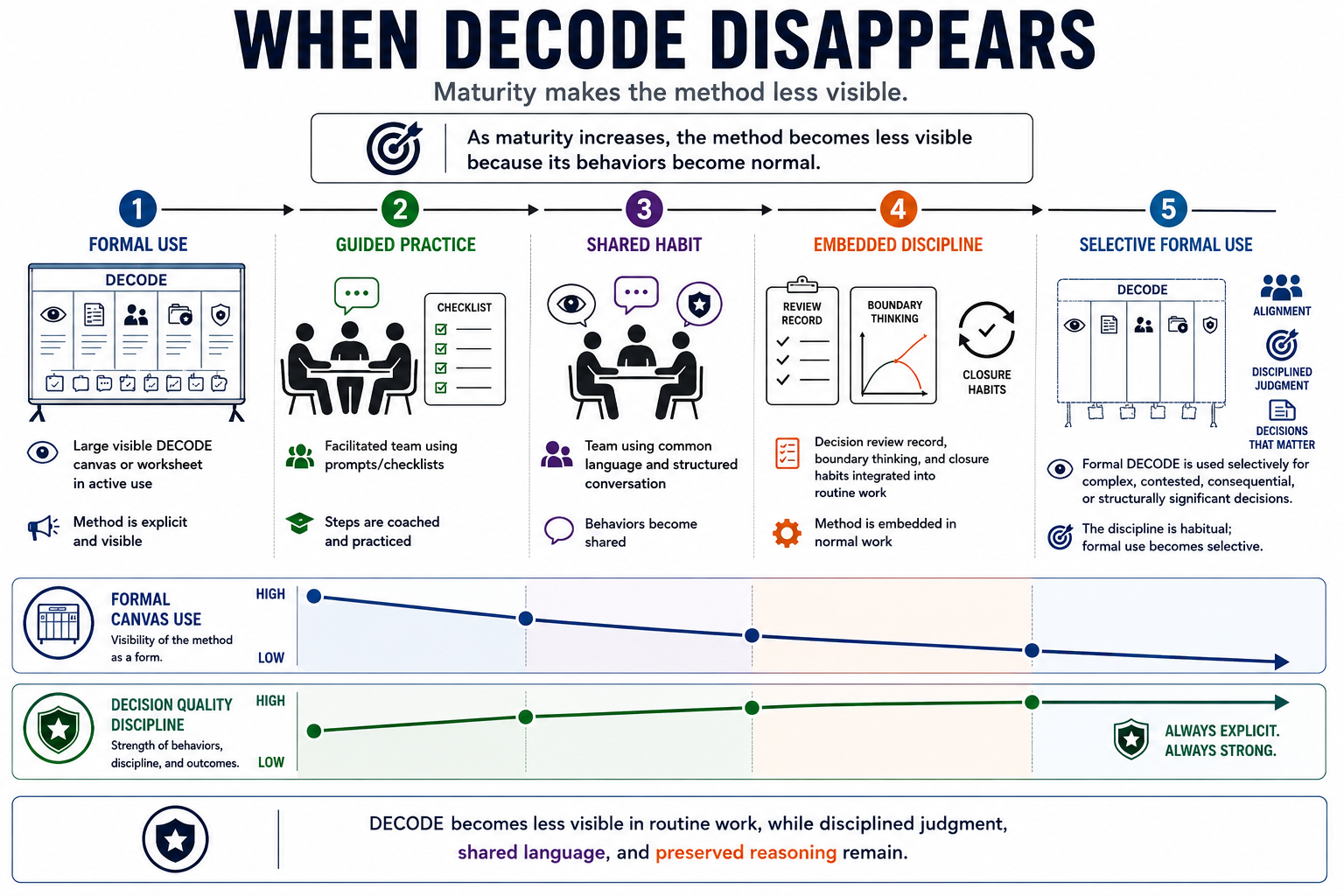
The goal is for the discipline to become habitual and formal use to become selective. Mature use of DECODE does not look like constant application. It looks like judgment becoming more disciplined about when formal application is necessary. As decision quality improves, many choices no longer require a full DECODE process. Intent is clearer. Boundaries are understood. Embedded decisions are recognized instinctively. Teams become better at distinguishing routine choices from decisions that create or materially reshape structure, dependencies, or long-term constraints. In such environments, DECODE becomes less visible in everyday work. Its discipline has been absorbed into how decisions are approached, while formal use remains available for decisions that are complex, contested, consequential, or structurally significant. This may sound paradoxical for a method, but it is deliberate. DECODE is not meant to become permanent ceremony around every decision. It is meant to build judgment so that formal structure is used where it adds value and omitted where the discipline is already sufficient. When DECODE becomes less visible, decision quality has not declined. It has matured.
From Method to Habit#
At first, DECODE feels explicit. Questions are written down. Steps are followed consciously. Conversations slow. The structure is visible and sometimes uncomfortable. Over time, something changes. Teams begin to ask better questions instinctively. Intent is clarified before problems are framed. Boundaries are named early. Assumptions are surfaced without prompting. Decisions are stated clearly and closed deliberately. The visible method may recede, but the behavior remains. This is the transition from method to habit. Formal DECODE is no longer required for every qualifying conversation, but neither is it abandoned. It becomes a deliberate tool used when the complexity or consequence of a decision justifies the additional structure.
What Remains#
When DECODE becomes less visible as a formal method, something remains.
- Teams pause before committing.
- Intent is clarified before problems are framed.
- Assumptions are named without defensiveness.
- Boundaries are discussed early rather than discovered late.
- Decisions are closed deliberately and revisited without blame. These behaviors persist even when the framework is no longer referenced. That persistence is the real measure of success. The result is that decisions remain legible, reasoning is preserved, disagreement becomes safer, and learning becomes cleaner. Organizations retain the ability to explain why they acted, why they did not, and what would justify deciding differently. What also remains is the option of formal DECODE when the decision warrants it. Habit does not replace the method. It allows the method to be used selectively and deliberately.
What Maturity Looks Like#
Decision maturity is not dramatic. It does not announce itself through new tools or language. It shows up in how conversations begin, how long they linger, and when they stop. Mature teams pause without apology. They resist premature solutions. They name uncertainty without embarrassment. They decide less often, but with more confidence. Most importantly, they are comfortable not acting when understanding is insufficient. This comfort is not passivity. It is control. Maturity also means recognizing when intuition and shared discipline are sufficient and when the significance of a decision requires formal DECODE.
When You No Longer Need the Form Every Time#
Forms are scaffolding. They exist to support thinking while discipline is being learned. When discipline is internalized, scaffolding may become unnecessary for routine decisions. At maturity, DECODE forms are used selectively. They appear when decisions are complex, contested, or consequential. They may be unnecessary when situations are clear, reversible, and comfortably within an already justified structure. What remains is the logic. Teams still define intent. They still describe before explaining. They still clarify embedded decisions. They still outline boundaries. They still decide explicitly and close deliberately. They simply do not need to document every decision through the full formal method.
The Quiet Outcome#
The success of DECODE is quiet. There are fewer initiatives launched without justification. Fewer unnecessary reversals. Fewer meetings that exist only to realign. Fewer explanations that begin with hindsight. Instead, there is steadier execution and calmer leadership. People trust decisions because they understand how they were made. Formal DECODE becomes selective rather than habitual ceremony. The discipline itself becomes part of everyday judgment.
Key Takeaway#
DECODE is not an identity and not a destination. It is a discipline meant to become habitual, with formal use reserved for the decisions that warrant it. When disciplined behavior persists without requiring the full method every time, while formal DECODE remains available for complex or consequential decisions, decision quality has become part of how the organization thinks. That is success.