Part II · What DECODE Actually Is (And Isn't)
05What DECODE Is Not
And Why Misuse Kills It#
DECODE stops working the moment it is treated as something familiar.
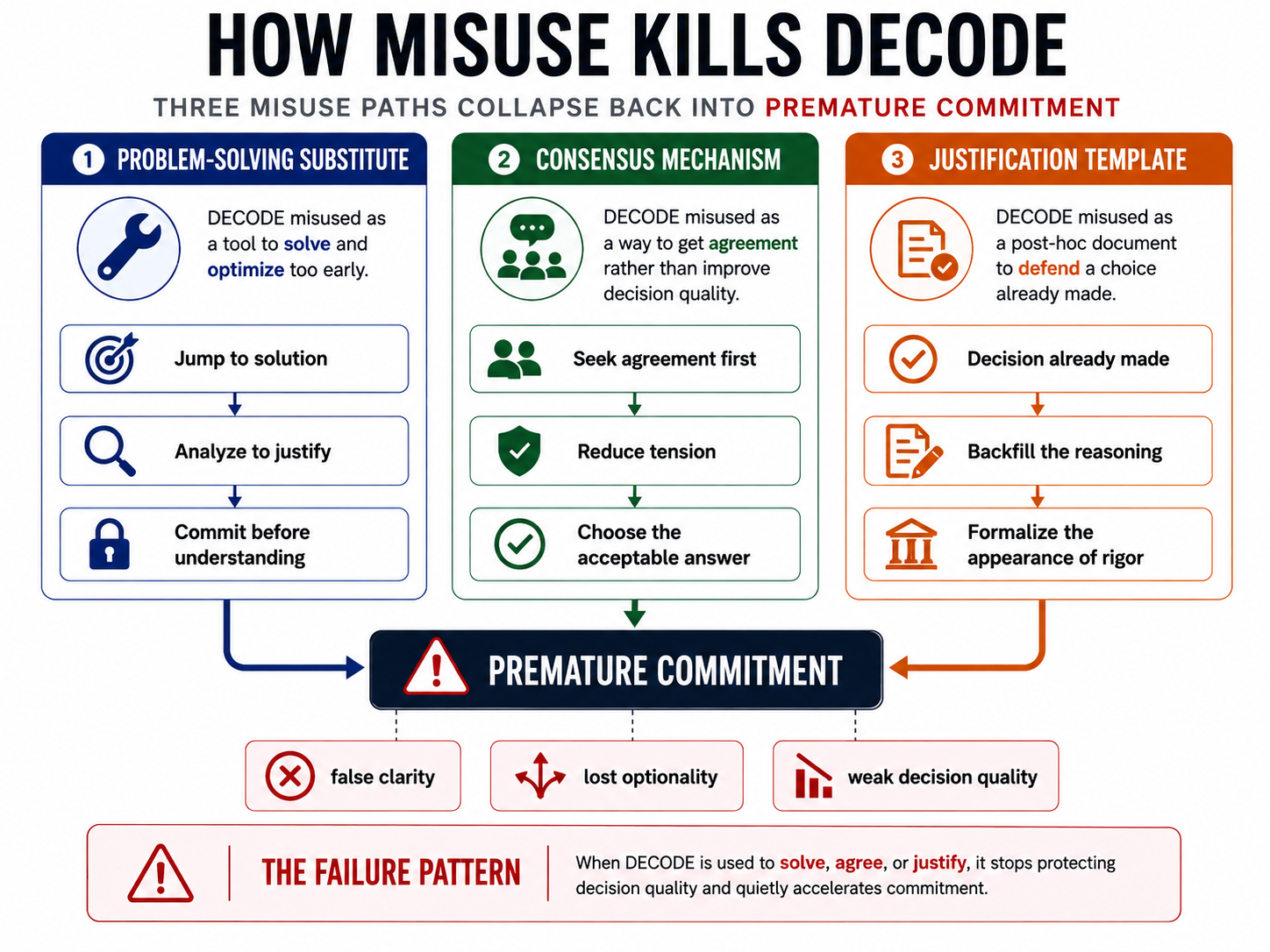
Because DECODE does not fit neatly into existing categories, it is often forced into them. Teams try to use it as a problem -solving tool, a consensus mechanism, or a justification format. Each of these interpretations feels reasonable. Each of them quietly destroys its value. Misuse does not merely reduce effectiveness. It reverses the intent of the method.
Common Misunderstandings#
DECODE is most often misunderstood in predictable ways. These misunderstandings are attractive because they align with existing habits and expectations. They also explain why DECODE fails when it is introduced without clear boundaries.
Mistaken for a Slower A3#
One of the most common mistakes is treating DECODE as a slower or more detailed version of an A3. In this view, DECODE is applied after a problem has already been accepted as real and worth solving. The expectation is that deeper analysis will produce a better solution or stronger justification for action. This is a fundamental misunderstanding. Problem-solving assumes that improvement is justified. DECODE does not. Its purpose is to decide whether commitment should occur at all. When DECODE is used after that decision has already been made implicitly, it becomes an analytical ritual rather than a decision discipline. The result is not better decisions. It is better documentation of premature ones.
Mistaken for a Way to Get Consensus#
Another common misuse is treating DECODE as a way to align stakeholders. In this interpretation, the method is expected to reduce disagreement, create buy -in, and produce agreement before action begins. Discomfort is treated as resistance rather than as a signal. DECODE is not designed to create consensus.
Its role is to make reasoning explicit. When reasoning is exposed, disagreement often increases. Assumptions clash. Boundaries are questioned. Trade-offs become visible. This is not failure. It is the point. When DECODE is used to smooth disagreement instead of revealing it, uncertainty is hidden rather than addressed. Alignment is achieved through compromise rather than understanding. The decision may feel safer. It is usually weaker.
Mistaken for a Justification Template#
The most damaging misuse is treating DECODE as a justification template. This happens when DECODE is applied after commitment has already occurred. Decisions are reconstructed. Assumptions are filled in retroactively. Logic is adjusted to fit outcomes. In this form, DECODE becomes a storytelling exercise. It no longer protects decision quality. It protects decisions from scrutiny. Once DECODE is used to justify rather than decide, it actively conceals uncertainty. At that point, using it is worse than not using it at all.
Why These Misuses Persist#
These misuses persist because they feel productive and safe. Problem-solving feels familiar. Consensus feels reassuring. Justification feels defensible. DECODE challenges all three instincts. It asks teams to pause when action feels urgent. It exposes disagreement instead of smoothing it. It requires reasoning before outcomes are known. These demands are uncomfortable. They are also essential.
Warning Signs of Misuse#
There are clear signals that DECODE is being misused.
- The decision is already assumed before the work begins.
- Solutions appear early and dominate discussion.
- Disagreement is treated as a problem to eliminate.
- The output is used to defend action rather than to decide it.
- The method feels bureaucratic instead of clarifying.
When these signs appear, DECODE has already lost its function.
How to Recover When DECODE Is Being Misused#
Misuse is rarely intentional. It usually appears after momentum has already formed. When that happens, attempting to correct everything at once only creates resistance. The most effective response is to interrupt the collapse point directly. If the decision already feels assumed, stop and restate the improvement intent. Ask whether that intent still justifies any commitment at all. If solutions dominate the discussion, park them explicitly and return to description of the system as it exists. Do not debate their quality yet. If disagreement is being suppressed in the name of alignment, surface assumptions instead. Name what must be true for the favored direction to be justified. In some cases, the only responsible move is to pause the decision entirely. A paused decision is recoverable. A silently committed one is not. Recovery does not require restarting the entire process. It requires restoring the separation between understanding and commitment.
Key Takeaway#
DECODE is not a problem-solving tool. It is not a consensus mechanism. It is not a justification format. It is a discipline for deciding whether commitment is justified in the first place. Using it as something familiar neutralizes its value. Using it to defend decisions destroys it. The next chapter defines when DECODE should not be used. After that, the six-step logic begins. Each step exists to answer a specific question that must be resolved before commitment can responsibly occur. This is where the method truly begins.