Part II · What DECODE Actually Is (And Isn't)
06When Not to Use DECODE
Using DECODE when it is not needed is a sign of immaturity, not rigor. Decision discipline is not about applying a method everywhere. It is about knowing when structure protects judgment and when it merely adds friction. DECODE is deliberately selective. It exists to protect decision quality only in situations where uncertainty is real, impact is high, and reversal would be costly. Applied outside those conditions, DECODE weakens both the method and the organization’s credibility. This chapter defines the boundaries of appropriate use. Knowing when not to use DECODE is as important as knowing how to use it.
Decision Hygiene#
Healthy organizations practice decision hygiene.
They distinguish between decisions that require careful structuring and those that do not. They resist the urge to formalize every choice. They understand that rigor applied indiscriminately becomes bureaucracy. DECODE is a discipline, not a reflex. It should be applied intentionally, not automatically. When teams begin to ask whether DECODE is required, rather than assuming it is, decision maturity is increasing.
Low-Risk and Reversible Decisions#
When the cost of being wrong is limited and the consequences are easily reversible, speed and learning through execution are more valuable than formal decision discipline. In such cases, delay introduces more cost than it avoids. Reversibility matters more than correctness. If a decision can be undone quickly without significant cost, effort, or loss of credibility, learning through action is not a failure of discipline. It is often the responsible choice. Using DECODE in these situations slows progress without meaningfully reducing risk.
Known Solutions#
DECODE should not be used when solutions are already known and justified. When a problem is well understood, system boundaries are clear, and a solution has been applied successfully before, the decision has effectively already been made. What remains is execution. Applying DECODE in these cases confuses decision discipline with problem -solving. It invites unnecessary debate and creates the impression that certainty is being questioned for its own sake. DECODE adds no value where understanding is already stable.
Execution Bottlenecks#
DECODE should not be used to resolve execution bottlenecks. When work is blocked by capacity limits, coordination failures, skill gaps, or lack of follow -through, the issue is not decision quality. It is delivery. Using DECODE here misdiagnoses the problem. It shifts attention away from accountability and toward analysis. It creates the appearance of progress while avoiding the harder work of execution. Execution problems require action, not further decision structuring.
The Cost of Overuse#
Overusing DECODE produces predictable failure modes. Teams begin to experience it as bureaucracy. Leaders perceive it as delay. Decisions lose momentum. The method becomes something to push through rather than something to think with. When this happens, DECODE no longer protects decision quality. It begins to erode trust. A discipline designed to preserve optionality becomes a source of friction.
Selective Use as a Marker of Maturity#
Decision maturity is visible in what an organization chooses not to formalize. Mature teams reserve DECODE for decisions that are consequential, uncertain, and difficult to reverse. They allow fast, informal decisions elsewhere. They do not confuse rigor with heaviness. Selective use is not avoidance. It is judgment.
A Simple Threshold Test#
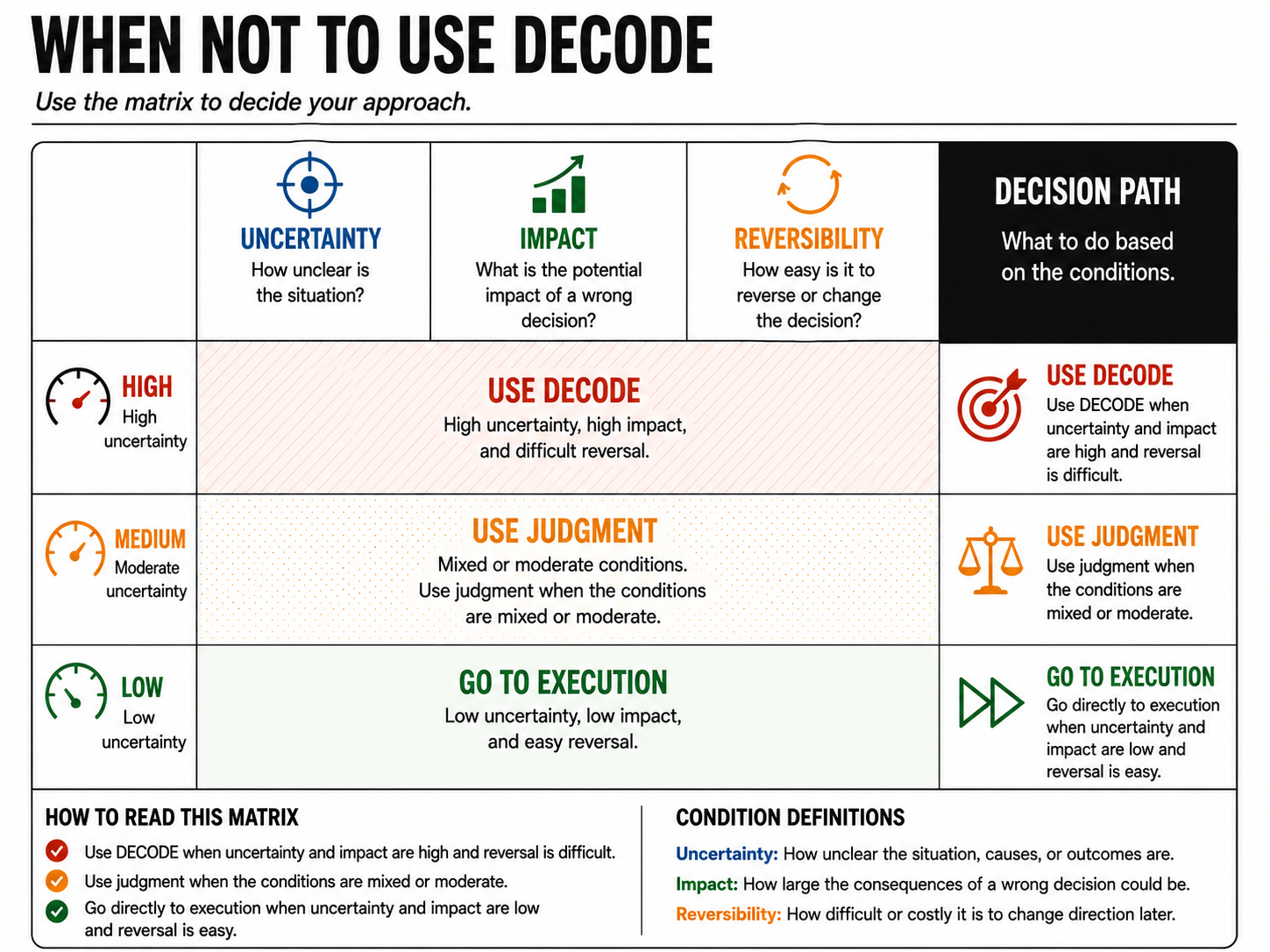
DECODE is not required for every decision. Using it everywhere weakens it. The following test provides a practical threshold. When uncertainty is real, impact is significant, and reversal is difficult or costly, use DECODE. When the conditions are mixed or moderate, use judgment. When uncertainty and impact are low and reversal is easy, proceed directly to execution. This test is intentionally simple. It is designed to be applied quickly, without debate, and without justification. Selective use of DECODE is not avoidance. It is a sign of decision maturity. The boundary can be summarized in one view.
Appropriate Use of DECODE#
Key Takeaway#
DECODE is not a universal tool. It should not be used for low-risk decisions, known solutions, or execution problems. Using it everywhere signals insecurity rather than discipline. Knowing when not to use DECODE is a sign that the organization understands both the method and itself. The next chapter introduces the DECODE steps as a complete sequence. Each step exists to answer a specific question that must be resolved before commitment can responsibly occur. That sequence is where the method becomes concrete.